Software-Defined Engineering for the Modern Media Era

The Flagpole Framework is an evolutionary necessity in broadcast engineering, marking a strategic pivot from manual drafting to data-centric modeling. In the contemporary media landscape, the shift from Serial Digital Interface (SDI) to SMPTE ST 2110 IP infrastructure has rendered traditional CAD-based documentation obsolete. We are no longer merely connecting boxes; we are managing a complex, software-defined environment where technical debt, in the form of "orphaned" drawings, poses a significant risk to facility lifecycle management.
This methodology finds its philosophical roots in James Burke’s Connections, which illustrated how the medieval stirrup eventually necessitated the development of pumps, the study of vacuums, and ultimately, the birth of television. Just as the stirrup changed the "hardware" of warfare and forced an entirely new economic and technological structure, ST 2110 has changed the "hardware" of media transport, demanding a documentation framework that treats engineering data as the ultimate source of truth.
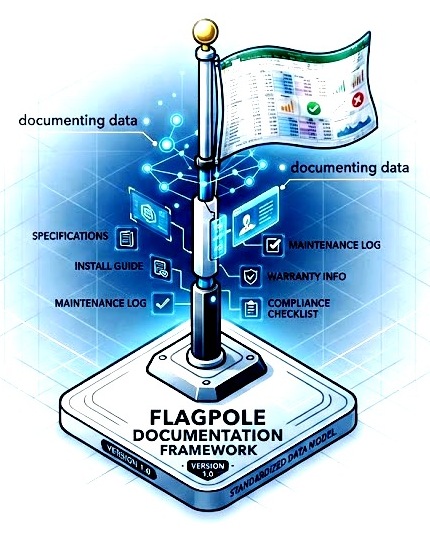
The conceptual foundation of this framework originated nearly three decades ago in a pivotal Sony presentation by Adam Salkin and the late Tom Harman. Their radical advice:"Forget the blocks," they introduced the "Flagpole" concept, where devices are represented as vertical anchors rather than static boxes. After thirty years of refining Excel VBA applications, the "missing link" was discovered through collaboration with AI as a technical mentor: the use of Excel Tables (ListObjects) to model the "DNA" of equipment. This transformation allowed for a "Headless Data Model," where the engineering model exists independently of its visual representation, transitioning the engineer from a drafter of pictures to a manager of an engineering documentation pipeline.
The Flagpole Framework enforces a rigid set of architectural rules designed to provide layout stability and prevent the "cascading redraw" failure common in traditional CAD environments. By adopting a Model-Based Systems Engineering (MBSE) approach, we ensure that documentation remains maintainable and searchable throughout the facility's lifespan.
This structured architecture paves the way for "Layered Logic" and Media Flow Views. By treating physical wires as just one attribute, the framework allows engineers to eventually generate Level 1-3 diagnostic layers, tracing uncompressed ST 2110 essence flows through logical IP fabrics as intuitively as they once followed an SDI signal.
In the Flagpole Framework, the Data Models function as the "Source Code" of the facility. A "Single Source of Truth" is the only defense against the inevitable drift between a facility's physical reality and its documentation.
These models work in concert via a structured Data Access Layer (DAL), ensuring that any change in the equipment DNA automatically ripples through every downstream "compiled" document.
The strategic decision to utilize Excel and VBA for the first reference implementation was made to eliminate the high barrier to entry for engineers. By using a ubiquitous platform, the framework removes the need for expensive CAD licenses and proprietary software training, allowing engineers to work in a table-driven environment they already use daily.
The Flagpole Framework is modeled after successful open-source ecosystems like Linux and Blender. Providing a vendor-neutral foundation expands the market for everyone, reducing Systems Integration (SI) costs and helping manufacturers become "Flagpole Ready" by providing standardized equipment definitions. This approach fosters a professional market for expert consulting, training, and certified implementations while ensuring the industry moves away from "dumb" pixels toward structured engineering data.
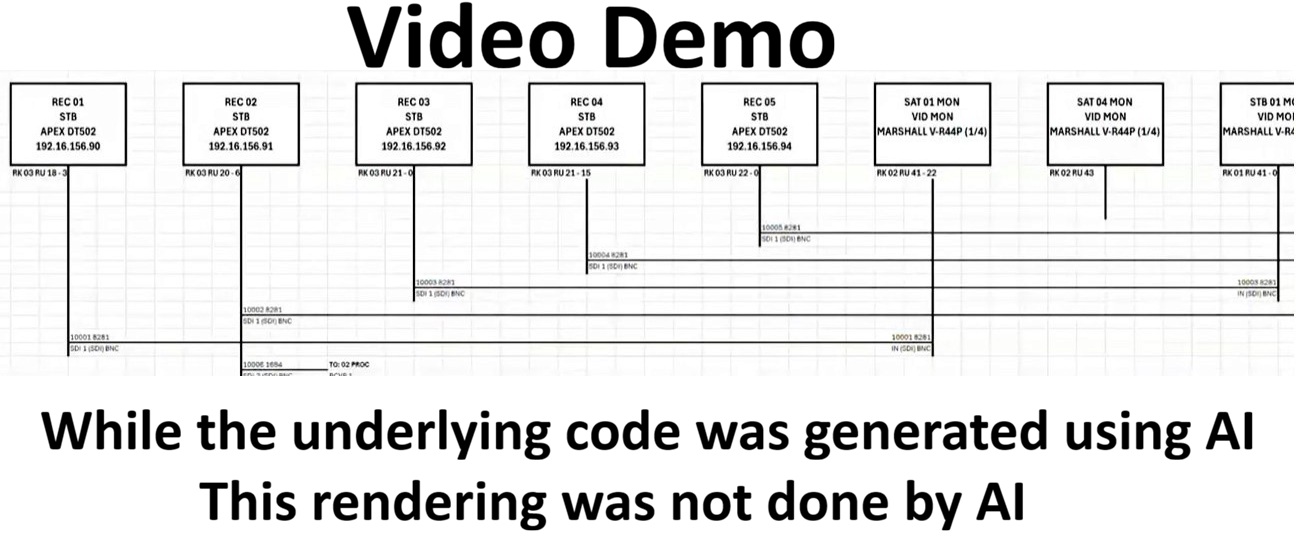
The framework is built on a structured Data Access Layer (DAL) and a modular rendering engine, designed for professional broadcast rigor
| Table Name | Functional Role |
|---|---|
| tblEquipment | Master inventory of all installed device instances. |
| tblModels | Physical and electrical specifications (the equipment "DNA"). |
| tblModelPorts | Detailed I/O definitions, including port names and signal types. |
| tblWireRuns | Physical connectivity ledger tracking all cable paths and connections. |
| tblLocations | Coordinate anchors for racks and frames; defines total capacity. |
| tblValidation | Centralized reporting for data integrity issues and schema violations. |
| tblRackPower | Automated power and BTU/HR thermal load calculations per rack. |
| tblJackfields | Passive infrastructure management and patch point synchronization. |
Macro Command Center
Quick Start Operation
The system utilizes a machine-readable location grammar (e.g., RK01-RU12 for front-mounted gear or FR03-SL07 for frame modules) to translate strings into grid coordinates. Operators can manage the entire documentation pipeline through a centralized command center, ensuring that the facility's documentation is as advanced as the IP fabric it describes.
The Flagpole Documentation Framework will strive over time to move from an engineering philosophy into a practical, open-source toolset. The long-term goal is to break free from traditional drawing restraints and start managing your documentation as a database.
In the near term
The Flagpole Documentation Framework will strive over time to move from an engineering philosophy into a practical, open-source toolset. The long term goal is to break free from traditional drawing restraints and start managing your documentation as a database.
The VBA code will be made available shortly. The code shouldn't be a black box. Over the next couple of weeks, the site will share a series of detailed guides explaining the overall architectural structure of the framework.
The base Excel spreadsheets will be made available via a few methods. Excel for the Web for cloud collaboration. Also via JSON & CSV structures for developers who want to decouple the data layer from Excel and feed it into other rendering engines, web applications, or CAD plugins.
To make operations as smooth as possible, a unified, interactive Control Panel is being developed over the next few weeks. You won't need to dig into the VBA editor to run the backend; the control panel will give you a simple, single-click interface to:
Along with the code and control panel, a simple, step-by-step operating instructions will be published shortly. These quick-start guides will show you exactly how to define physical models, coordinate locations, rack equipment, and generate comprehensive documentation sets in minutes
The Flagpole reference implementation is provided free of charge for people to use and evaluate. The framework's concepts and methodology are openly documented, but the software is not currently being released as open source. Copyright and control of the source code remain with the project.