 Study Plan
2110 Topo
Study Plan
2110 Topo
ST 2110-40 defines the transport of ancillary data (often called “ANC data”) as a separate essence flow over IP. This includes captions, timecode, SCTE 104/35 triggers, AFD, and other metadata.
What a 2110 System Designer Must Know
-
 Ancillary Data is sent as its own independent IP stream — not embedded inside the video like in traditional SDI.
 - It uses RTP/UDP multicast, just like 2110-20 (video) and 2110-30 (audio).
- Timing is critical: All ancillary data is timestamped using the same PTP clock as video and audio.
- Common payloads include:
- Closed Captions / Subtitles (CEA-608/708)
- Timecode (LTC/VITC via SMPTE ST 12-1/12-2)
- SCTE 104 / SCTE 35 triggers (ad insertion, program signaling)
- Active Format Description (AFD)
- Camera metadata, tally, and production control data
Why Ancillary Data Flows Are Separate
This is one of the core principles of ST 2110 — essence separation:
- Allows independent routing and processing of video, audio, and data.
- Enables more flexible system design (e.g., sending captions to different destinations than video).
- Improves scalability and redundancy — you can protect ANC data separately using ST 2022-7.
- Simplifies integration with IT-based systems and cloud workflows.
- Reduces risk — a problem with captions doesn’t affect the video stream.
Treat ANC data (2110-40) as a first-class citizen. It must be synchronized to the same PTP clock as video and audio. Plan your multicast addressing, bandwidth, and redundancy for it just like you do for the main video and audio essences.
ST 2110-40 Ancillary Data – Common Types & Implementation
ST 2110-40 carries ancillary data as its own independent essence flow over IP. Below is a breakdown of the most common types, what typically generates them, and how they are converted into 2110 IP streams.
1. Closed Captions / Subtitles (CEA-608 / CEA-708)
- Generated by: Captioning systems, live captioners (stenographers), or automated speech-to-text systems.
- Physical Interface: Usually RS-422 serial, USB, or Ethernet from the caption encoder. In legacy setups, embedded in HD-SDI (Line 21 / VANC).
- Implementation in 2110: Converted via a 2110 gateway or software encoder into a dedicated 2110-40 multicast stream.
Example: Extracting CTA-708 Closed Captions from ST 2110-40
To extract CTA-708 Closed Captions from an ST 2110-40 ancillary data stream, the receiver must filter for a specific Data Identifier (DID) value inside the packet payload.
The Required DID / SDID Values
SDID = 0x01
These two values together identify CEA-708 digital closed captions in the ancillary data stream.
Parser Code Snippet (Python Example)
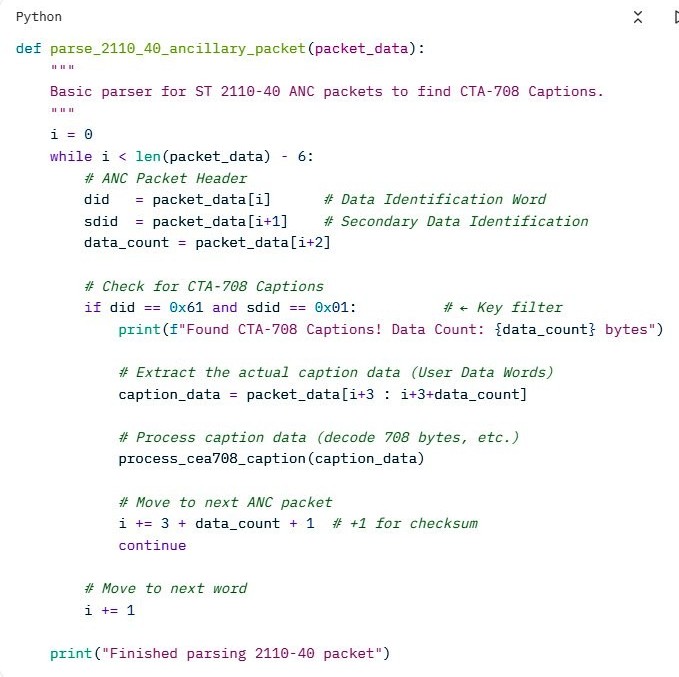
Why This Combination?
- DID 0x61 identifies caption-related ancillary data.
- SDID 0x01 specifically selects CEA-708 (modern digital captions).
- Other values are used for different data types (e.g., DID 0x60 for timecode, DID 0x61/SDID 0x02 for SCTE 104).
A 2110-40 parser looking for closed captions should scan for DID = 0x61 and SDID = 0x01. This is the standard identifier used in both traditional SDI VANC and in ST 2110-40 IP streams.
Missing or Broken Closed Captions in ST 2110-40
If a downstream device (multiviewer, compliance logger, monitor, etc.) reports that closed captions are completely missing or broken, but a packet capture confirms the ST 2110-40 stream is physically arriving at the port, the problem is almost always in the SDP (Session Description Protocol).
The Most Common Cause
The receiver is not parsing the ancillary data because the SDP is either:
- Missing the
a=fmtpline that declares the caption data, or - Using incorrect DID/SDID values.
Correct SDP for CTA-708 Captions
		m=application 50000 RTP/AVP 96
		a=rtpmap:96 ancillary/90000
		a=fmtp:96 DID=0x61,SDID=0x01
Why This Happens
- The 2110-40 stream contains the caption data (DID 0x61 / SDID 0x01), but the receiver doesn’t know to look for it.
- Without the proper
a=fmtpdeclaration, the device ignores the ancillary packets or treats them as unknown data. - This is one of the most frequent issues when integrating multiviewers, recorders, and monitoring systems with 2110-40 caption streams.
If packets are arriving but captions are missing → Check the SDP first. Make sure it correctly declares
DID=0x61, SDID=0x01 for CTA-708 captions.
This is a very common configuration error in ST 2110 deployments.
2. Timecode (LTC / VITC via SMPTE ST 12-1 / ST 12-2)
- Generated by: Master clock systems, video servers, cameras, or automation systems.
- Physical Interface: LTC (Linear Timecode) via balanced analog audio cable (XLR), or embedded as VANC in HD-SDI.
- Implementation in 2110: Most facilities use ST 12-2 Ancillary Timecode (ATC) carried in a 2110-40 stream, locked to the facility PTP clock.
How Ancillary Timecode (ATC) is Carried in ST 2110-40
Ancillary Timecode (ATC) is transported in ST 2110-40 as a dedicated ancillary data packet, following the same structure used in traditional SDI VANC.
Technical Identifiers
SDID = 0x60
Standard: SMPTE ST 12-2 (Ancillary Timecode)
ATC packets are carried inside 2110-40 RTP streams and use the same 90 kHz RTP clock and PTP timing reference as video (2110-20) and audio (2110-30).
Problems This Resolves Compared to Legacy LTC / VITC
| Issue | Legacy LTC / VITC | ST 2110-40 ATC |
|---|---|---|
| Distribution | Separate cables or embedded in SDI | Same IP network as video & audio |
| Routing Flexibility | Limited (point-to-point) | Any-to-any via multicast |
| Synchronization | Prone to drift and jitter | Locked to facility PTP clock |
| Redundancy | Difficult | ST 2022-7 hitless protection |
| Scalability | Poor in large facilities | Excellent |
ST 2110-40 ATC replaces fragile, hard-to-route legacy timecode distribution with a clean, PTP-synchronized, network-native solution. Because it uses the same timing reference as video and audio, timecode stays frame-accurate across the entire facility without manual delay compensation.
3. SCTE 104 / SCTE 35 Triggers (Ad Insertion & Program Signaling)
- Generated by: Automation systems, traffic/playout systems, or live event triggers.
- Physical Interface: Typically RS-422, GPIO, or IP (Ethernet) from the automation system. SCTE 104 is the upstream trigger format.
- Implementation in 2110: Converted into 2110-40 ancillary packets. SCTE 35 messages are often generated downstream by a splicer.
4. Active Format Description (AFD)
- Generated by: Cameras, video servers, graphics systems, or upstream converters.
- Physical Interface: Usually embedded in the vertical ancillary (VANC) space of HD-SDI.
- Implementation in 2110: Extracted from SDI and carried as SMPTE 2016-1 packets in a 2110-40 flow.
5. Camera Metadata, Tally, and Production Control Data
- Generated by: Broadcast cameras, robotic camera systems, switchers, and production control surfaces.
- Physical Interface:
- Camera metadata: Often embedded in HD-SDI or via proprietary camera control protocols (e.g., SMPTE 2059, IP-based).
- Tally & control: GPIO, RS-422, or network-based (Ethernet).
- Implementation in 2110: Converted via gateways or native IP cameras into one or more dedicated 2110-40 streams.
How ST 2110-40 Handles Packet Transmission
Unlike ST 2110-20 video, which sends massive continuous streams of pixel data, ST 2110-40 (Ancillary Data) operates very differently.
Key Difference in Transmission
- ST 2110-20 (Video): Sends a continuous, high-bandwidth stream of packets for every video frame — essentially a constant flow of data.
- ST 2110-40 (Ancillary Data): Is data-driven. Packets are sent only when there is actual data to transmit.
How 2110-40 Packet Transmission Works
ST 2110-40 does not send a packet for every video line. Instead:
- Ancillary data (captions, timecode, SCTE triggers, AFD, etc.) is buffered as it arrives.
- When data is present, it is packaged into RTP packets and sent over multicast.
- If there is no new ancillary data, no packets are transmitted.
- This makes 2110-40 transmission bursty and infrequent compared to video and audio streams.
Practical Examples
- Closed Captions: Packets are sent several times per second only when dialogue is present.
- Timecode: Usually updated once per frame or less.
- SCTE Triggers: Sent only when an actual ad insertion or signaling event occurs.
ST 2110-40 is an event-driven essence. It only uses network bandwidth when there is data to send. This makes it far more bandwidth-efficient than video (2110-20) or audio (2110-30), but it still requires proper PTP timing and reliable multicast delivery so the occasional packets arrive correctly synchronized with the main program.
Why ST 2110-40 Packets Are Susceptible to Jitter — and How QoS Fixes It
Because ST 2110-40 ancillary data packets are very small and sent infrequently (bursty), they are highly vulnerable to network issues on a busy switch.
The Main Problem: Jitter & Head-of-Line Blocking
On a congested switch, a large 2110-20 video packet (which can be several thousand bytes) may already be in the transmit queue when a tiny 2110-40 ANC packet arrives.
The small ANC packet is forced to wait behind the large video packet(s). This introduces unpredictable queuing delay and jitter.
This jitter can cause problems with timing-sensitive data such as:
- Closed captions (delayed or dropped captions)
- Timecode (inaccurate or jumping timecode)
- SCTE triggers (missed ad insertion cues)
How Quality of Service (QoS) Prevents This
- Proper Marking:
- PTP packets → CS6 (highest priority)
- 2110-40 Ancillary Data → CS5 or AF41 (high priority, but below PTP)
- Priority Queuing: The switch transmits higher-priority packets (PTP and ANC) first, ahead of large video packets.
- Traffic Shaping (ST 2110-21): Video streams are paced smoothly, reducing massive bursts that block smaller packets.
ST 2110-40’s bursty, low-bandwidth nature makes it vulnerable to jitter caused by large video packets. Proper QoS marking and priority queuing ensure these critical but tiny packets are not delayed, maintaining reliable delivery of captions, timecode, and triggers across the network.
ST 2110-40 RTP Clock Frequency
According to SMPTE ST 2110-10 (System Timing and Definitions), the RTP clock frequency used by ST 2110-40 Ancillary Data is:
90,000 Hz (90 kHz)
This is the same RTP clock rate used by ST 2110-20 Video.
Why 90 kHz? Why does it match the video stream?
- Video Compatibility — Most professional video frame rates (especially 59.94, 29.97, etc.) divide cleanly into 90,000. This enables precise frame-accurate timestamping.
- Common Timing Plane — Using the same 90 kHz clock for both video and ancillary data allows all RTP timestamps to be derived from the shared PTP clock. This makes synchronization much simpler.
- Seamless Lip-Sync & Alignment — Captions, timecode, SCTE triggers, and other ancillary data stay perfectly aligned with the video frames without complex timestamp conversion.
ST 2110-40 uses a 90 kHz RTP clock by design so that ancillary data remains tightly synchronized with the video essence using the same PTP timing reference. This unified timing approach is one of the biggest advantages of the ST 2110 architecture.
In modern 2110 facilities, most ancillary data is converted from legacy physical interfaces (SDI, RS-422, GPIO) into dedicated 2110-40 IP flows using gateways or software-based encoders.
Plan separate multicast addresses and ST 2022-7 redundancy for critical data such as captions and SCTE triggers.
Design Best Practice:
Treat 2110-40 ancillary data as a first-class essence. Give it proper PTP synchronization, dedicated multicast addressing, and ST 2022-7 redundancy where needed. Many facilities run separate ANC flows for captions, timecode, SCTE triggers, and production metadata to maximize routing flexibility.