
 Study Plan
2110 Topo
Study Plan
2110 Topo
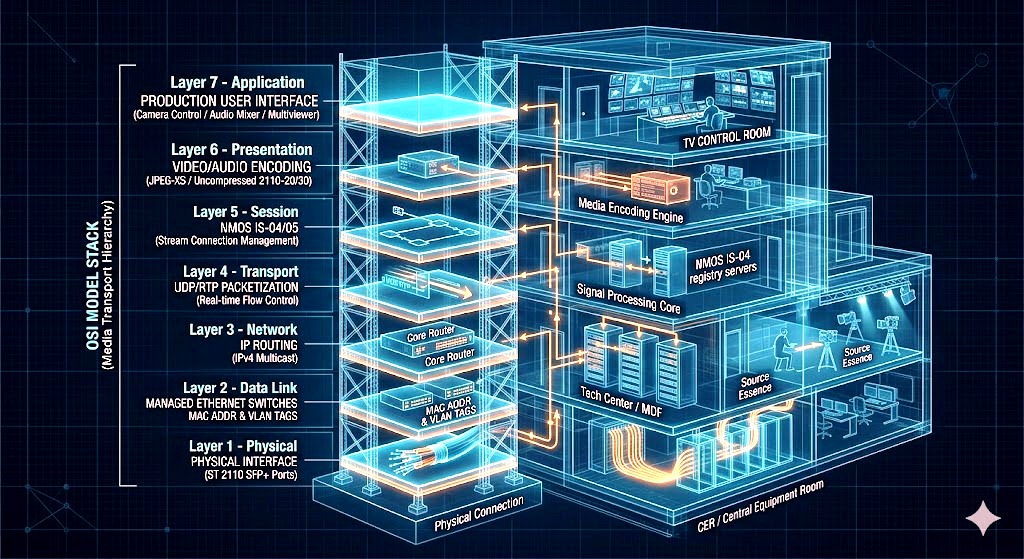
This lesson explains Internet Group Management Protocol and how it fits into the SMPTE ST 2110 stack.
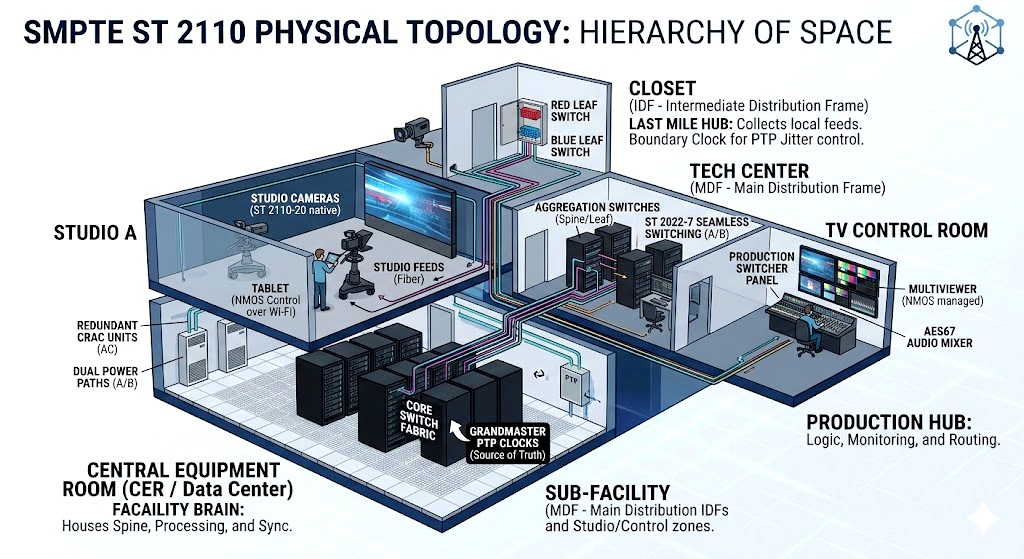
• The Hierarchy of Space
• 2110 vs. Standard IT: The Critical Differences
In a 2110 environment, "where" equipment is placed is dictated by two things: Physics (cable distance) and Logic (network hierarchy). While the industry often uses these terms interchangeably, there are distinct differences in how they serve a broadcast plant.
Heat & Cooling Calculations eBay Computer Closet Meltdown
What it is: A small, distributed satellite location, often just a rack in a literal closet or a wall-mount cabinet.
2110 Role: The "Last Mile" connection. It houses Leaf Switches that collect local camera and monitor feeds.
Nuance: In 2110, an IDF is rarely just "passive" patch panels; it must be a "managed" space because 2110 switches require active cooling and stable PTP timing.
 What it is: A larger, more centralized hub that serves an entire floor or a specific wing (e.g., "The Sports Tech Center").
2110 Role: An aggregation point. It links multiple IDFs together and often houses the Spine Switches or localized processing gear (Gateways, Multiviewer engines).
Nuance: This is usually the first place you'll find "A/B" path redundancy (ST 2022-7) with fully independent power and networking.
What it is: The "Brain" of the facility. A highly controlled, large-scale environment with raised floors and massive cooling.
2110 Role: This is where the Core Router and Grandmaster Clocks live. Every signal in the building eventually "touches" the CER.
Nuance: In a 2110 plant, the CER looks identical to a modern Data Center. The "Router" is no longer a video matrix, but a high-density IP Switch fabric.
| Requirement | Standard IT Closet | ST 2110 Closet/Tech Center |
|---|---|---|
| Cooling (HVAC) | Passive or minimal. | Active & Redundant. 2110 switches generate immense heat from high-speed SFP+ ports. |
| Cabling | Mostly Cat6 Copper. | 90% Single-Mode Fiber. 2110-20 (Video) bandwidth exceeds copper limits quickly. |
| Timing | NTP (Computer time). | PTP (Precision Time). Switches must support Boundary Clock mode to prevent jitter. |
| Power | Single UPS. | Dual-Feed (A/B). Essential for "Hitless" redundancy under ST 2022-7. |