 Study Plan
2110 Topo
Study Plan
2110 Topo
This lesson explains how Dynamic Media Facilities are taking over media operations.
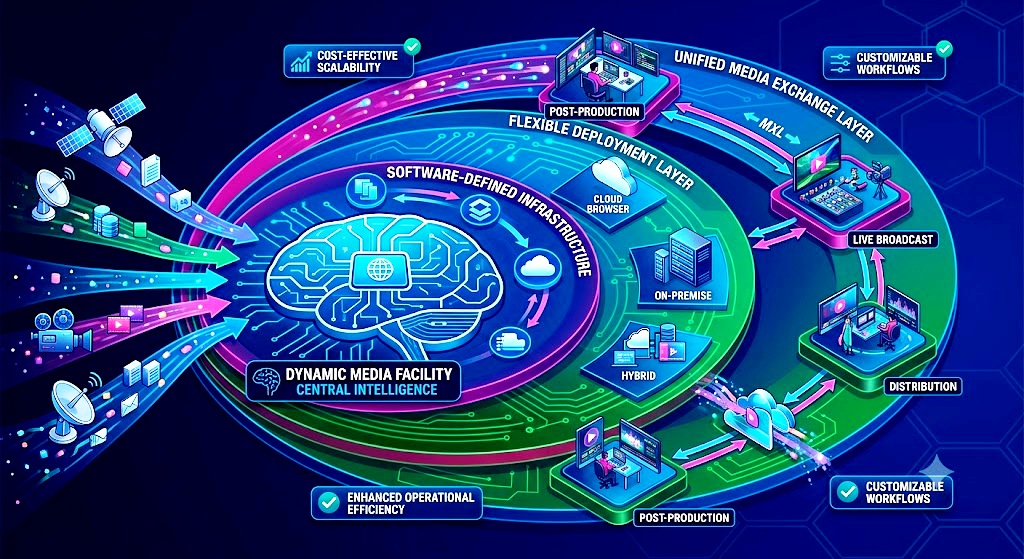
Dynamic Media Facilities are media production and distribution environments built around software-defined, reconfigurable, IP-connected infrastructure instead of fixed-function hardware chains.
Traditional facilities were hardware-centric, permanently wired, and purpose-built. Dynamic facilities are software-controlled, adaptable, virtualized, cloud-aware, and workflow-driven.
Camera → Router → Switcher → Audio Console → VTR → Master Control
Traditional systems relied on SDI wiring, dedicated hardware, fixed signal paths, and physical patching.
Modern facilities may use software routers, virtual multiviewers, processing nodes, cloud replay, remote operators, and orchestration layers.
Instead of asking “What room is this equipment in?” the question becomes “What resources are available right now?”
Dynamic facilities are commonly built around SMPTE ST 2110, multicast networking, Precision Time Protocol (PTP), and commercial Ethernet switching.
Functions such as switchers, replay, graphics, multiviewers, and audio processing increasingly run as software instead of dedicated hardware.
Resources can be assigned and reassigned as production needs change, allowing facilities to adapt rapidly to different events and workflows.
Orchestration systems manage signal discovery, subscriptions, bandwidth, permissions, and processing allocation across the facility.
Dynamic facilities often support REMI and geographically distributed production, where production staff may operate remotely from the event location.
Software-defined infrastructure allows resources to scale dynamically based on production requirements.
Broadcasters and media companies seek greater flexibility, lower hardware dependence, remote operation capabilities, faster deployment, and cloud scalability.
Dynamic facilities require knowledge of networking, timing, multicast, orchestration, virtualization, cybersecurity, and software infrastructure.
A Dynamic Media Facility is a software-defined, IP-connected (Not Hardware-Wired), orchestrated production environment where media resources can be allocated, reconfigured, and scaled dynamically instead of being permanently tied to fixed hardware workflows.
In a DMF, the media functions (e.g., encoding, mixing, processing) are virtualized or containerized (running on Kubernetes/cloud).
Instead of buying hardware that sits idle 90% of the time, DMF promotes "spinning up" production workflows as needed and tearing them down when the show is over.
This is the core "glue" of the DMF. It provides a universal, low-latency way for these software functions to share media, solving the problem of how to move uncompressed data between containers without losing the timing precision that 2110 requires.
One more important note: ST 2110 is the foundation, not the solution. If you think of ST 2110 as the "language" or the "wire" (a set of standards for how to packetize and time media), then DMF is the "operating system" for the whole building.
ST 2110 does not tell you how to orchestrate: ST 2110 tells you how a 1080p video packet should be formatted and timed (ST 2110-20/21) and how it should be synchronized to a PTP clock (ST 2059). However, it says nothing about how to automatically spin up a virtual container when a director asks for a new multiviewer, how to move that video between containers, or how to manage the lifecycle of that production.