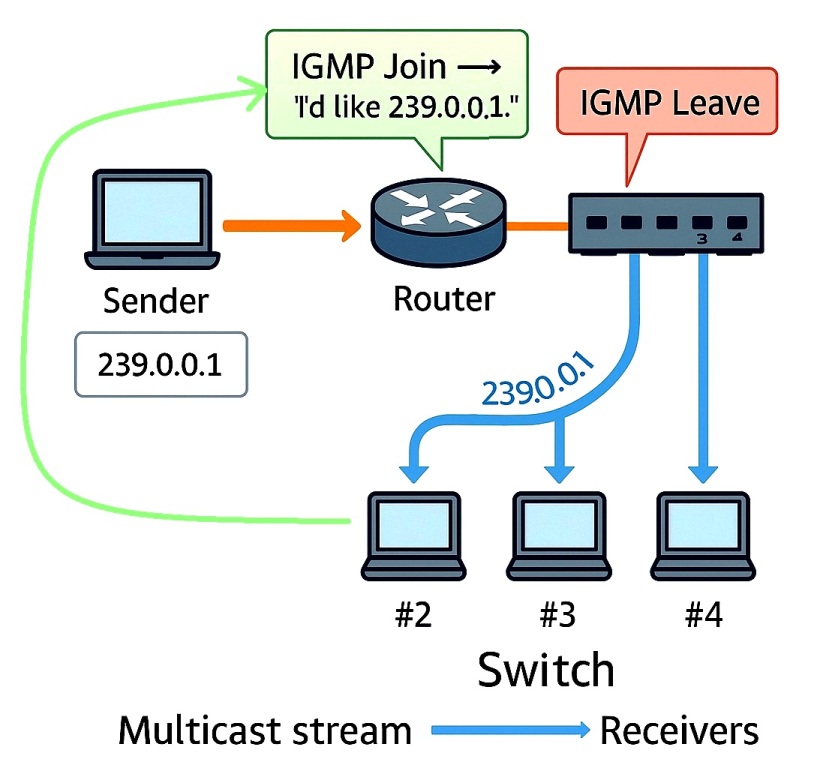
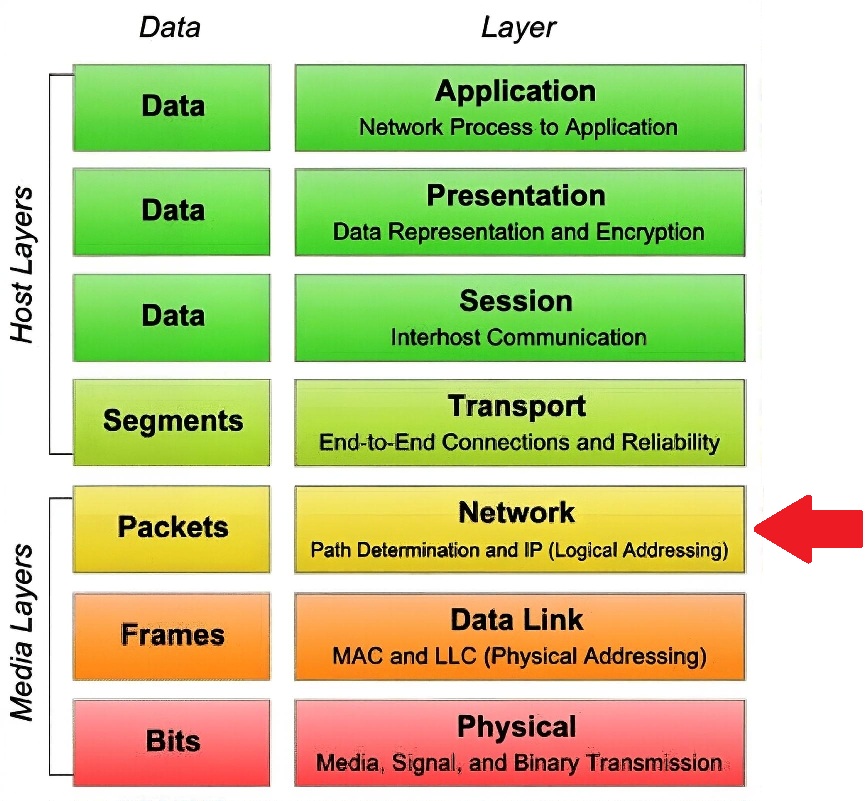
 Study Plan
2110 Topo
Study Plan
2110 Topo
This lesson explains Internet Group Management Protocol and how it fits into the SMPTE ST 2110 stack.
• IGMP Introduction
• How Multicast Works
• IGMP Snooping
• Troubleshooting
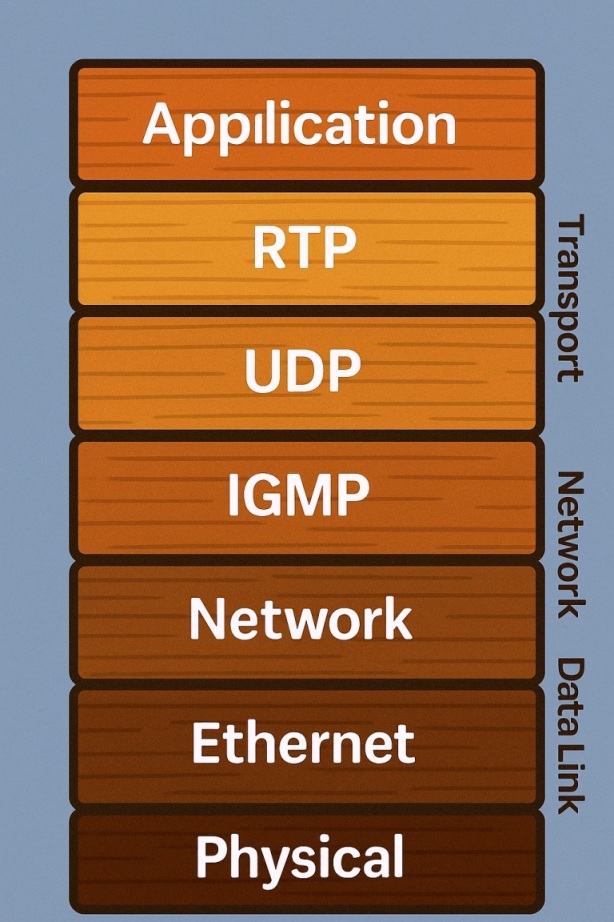
IGMP stands for Internet Group Management Protocol. It is a control protocol used by IP hosts (such as computers, cameras, or decoders) and routers to manage multicast group memberships on a local network (Layer 3).
IGMP and multicast go hand-in-hand in networking, especially for video applications like SMPTE ST 2110, IPTV, or streaming contribution systems
.
 When you want to receive a multicast stream (e.g., a video feed sent to 239.0.0.1), your device tells the local router or switch: “I want to join multicast group 239.0.0.1.” That message is an IGMP Join.
| Layer | Function | Example Protocols |
|---|---|---|
| Layer 3 (Network) | Controls multicast membership | IGMP (IPv4) or MLD (IPv6) |
| Layer 2 (Data Link/Switching) | Forwards multicast only to ports that have joined | IGMP Snooping |
How Multicast Works
Example multicast address ranges:
IPv4: 224.0.0.0 – 239.255.255.255
Common for private/streaming/video use: 239.0.0.0/8 (organization-local scope)
Instead of sending one copy of the video stream per viewer (as in unicast), the sender transmits a single copy to the multicast IP address. Switches and routers replicate packets only to interfaces (ports) that have joined that group.
IGMP is a Layer 3 (Network layer) protocol and manages multicast group membership between hosts and routers. Layer 2 switches do not natively understand IP multicast, but if equipped with IGMP Snooping, they listen to IGMP messages to optimize forwarding. IGMP itself does not live at Layer 2.
| Version | Main Improvement |
|---|---|
| IGMPv1 | Basic joins; no explicit leave (relies on timeout) |
| IGMPv2 | Adds leave messages, quicker pruning. |
| IGMPv3 | Supports source-specific multicast SSM — only from a specific sender. |
Additional
SSM
SSM (Source-Specific Multicast) is a bit like switching from an "open party" to a "private guest list." Why use it? Modern multicast video systems (SMPTE 2110, IPTV, etc.) typically use IGMPv3.
In SMPTE 2110 or IPTV systems Broadcast/Media Applications:
Traditionally, multicasting used Any-Source Multicast (ASM), where a receiver would join a group and get traffic from anyone broadcasting to it. SSM changes the game by requiring the receiver to specify exactly which sender they want to hear from.
How SSM Works with IGMP
SSM relies specifically on IGMPv3 (for IPv4) or MLDv2 (for IPv6). Earlier versions of IGMP simply didn't have the "fields" in their packets to carry source information.
The "Include" List: When a host wants to receive a stream, it
Key Advantage
Benefit
Address Uniqueness
Different sources can use the same multicast group address without interfering with each other, because the
(S, G) pair uniquely identifies the stream.
Security
Prevents denial-of-service attacks from rogue sources; the receiver only accepts traffic from the
source it explicitly requested.
Simplified Routing
Eliminates the need for complex protocols such as MSDP (Multicast Source Discovery Protocol), since the receiver already knows the source.
Efficiency
The network does not flood traffic to discover receivers; it builds a direct path from the receiver to the known source immediately.
Think of it like a Podcast subscription vs. a CB Radio. In a CB radio (ASM), you tune to a channel and hear everyone talking. In a Podcast (SSM), you specify the exact show (Group) and the exact host (Source) you want to download from. It’s cleaner, safer, and much easier for ISPs to manage info.
IGMP Snooping
IGMP Snooping is a Layer 2 switch feature that optimizes multicast traffic forwarding in Ethernet networks. Normally, a Layer 2 switch treats multicast frames like broadcast frames and floods them to all ports in the VLAN.
With IGMP Snooping enabled, the switch listens (snoops) to IGMP messages (Membership Reports/Joins and Leaves) exchanged between hosts and routers.
It builds a table mapping multicast group addresses (e.g., 239.0.0.1) to specific switch ports that have joined those groups.
The switch then forwards multicast packets only to the ports that have subscribed to the group, instead of flooding them everywhere.
Key benefits:
• Dramatically reduces unnecessary multicast traffic on the network.
• Prevents bandwidth waste and performance degradation (especially important for high-bandwidth applications like video streaming, SMPTE ST 2110, IPTV, or IP audio).
• Improves network efficiency in VLANs with many devices.
Requirements for full effectiveness:
• Usually needs an IGMP Querier (often a router or a designated switch) to periodically ask hosts which groups they are still interested in. Without a querier, snooping may not work reliably (some switches can act as querier themselves).
• In short: IGMP Snooping makes multicast behave more like unicast (delivered only where needed) at Layer 2, rather than flooding like broadcast. It's a standard and essential feature on managed switches in any multicast-heavy environment.
(Layer 2 Switch Feature)
Layer 2 switches normally treat multicast like broadcast and flood it to all ports.
With IGMP Snooping enabled, the switch listens to IGMP Join/Leave messages and builds a table mapping multicast groups to specific ports.
This dramatically reduces unnecessary traffic: multicast packets are forwarded only to subscribed ports.
In a multicast network, hosts send IGMP Membership Reports (Joins) when they want to receive a group, but they don't continuously announce membership. Without periodic queries, the router/switch wouldn't know when hosts have left a group (e.g., user closed a video stream), leading to unnecessary multicast traffic continuing to be forwarded.
• The Querier periodically sends IGMP Query messages to the all-systems multicast address (224.0.0.1) on the subnet/VLAN.
• All hosts that are members of any multicast group must respond with an IGMP Membership Report listing the groups they still want.
• The Querier uses these reports to update its group membership table.
• If a host wants to leave a group, it sends an IGMP Leave message (IGMPv2/v3); the Querier may send a group-specific query to confirm no one else is interested before stopping forwarding that group.
• If no response comes for a group after timeouts, the Querier assumes no hosts are interested and stops forwarding that multicast stream.
Only one Querier should be active per subnet/VLAN to avoid duplicate queries (IGMPv2/v3 use an election process based on lowest IP address). In many modern managed switches with IGMP Snooping enabled, the switch can act as the Querier if no multicast router is present (this is called a "Querier-enabled switch").
The IGMP Querier is the "pollster" that keeps asking "Who still wants this multicast channel?" so the network can stop sending it when nobody is watching anymore.
) track memberships and forward streams only to interested ports.
Think of multicast like cable TV over IP:
In a properly configured multicast domain:
IGMP is the control plane mechanism that enforces this.
If IGMP snooping is disabled or not functioning the switch treats multicast as broadcast. Floods multicast to every port in the VLAN.
Symptoms:
Even if IGMP snooping is enabled, but there is no IGMP querier:
(This is extremely common in broadcast plants) this is what the switch does:
If there are no periodic queries, memberships cannot be refreshed.
IGMP packet counters tell the story:
On managed switches: IGMP Queries: zero or very low, IGMP Reports: present, IGMP Leaves: present.
If there are no periodic queries, memberships cannot be refreshed.
Its possible to have a Querier present on one VLAN, and missing on others. That might be the case if a VLAN floods after a few minutes
What happens if you have partial snooping or mis-scoped VLANs?
This is common in 2110 systems with management + media VLANs.
Symptoms:
Why this matters in ST 2110 environments:
Short summary