The broadcast industry is currently caught in a "temporal squeeze." While SMPTE ST 2110 provides the technical agility to move toward Software-as-a-Service (SaaS) and direct-to-consumer models, the industry remains tethered to engineering decisions made in 1953 to accommodate black-and-white vacuum-tube televisions.
Even in an all-digital, IP-encapsulated world, several "DNA markers" from the analog era persist in ST 2110 to maintain compatibility with historical archives and legacy consumer displays.
| Legacy Artifact | The 1950s (or earlier) Origin | The 2110 Implementation | Reason for Persistence |
|---|---|---|---|
| 59.94 Hz Frame Rate | Adjusted from 60Hz by 0.1% to prevent color subcarrier interference with audio. Not to mention the NTSC's Four-Field Color Frame issues | Maintained via the 1.001 fractional rate. | Deeply baked into North American production switchers and consumer TV sync. |
| Interlaced Video (1080i) | Actually this one goes back to the early 1920s! A bandwidth-saving trick that sent half the lines of a frame at a time. | Defined in ST 2110-20. | Many news/sports playout chains and "legacy" archives still operate in 1080i. | 4:2:2 Chroma Subsampling | Reducing color data because human vision is more sensitive to brightness (Luma). | The "default" sampling for 2110-20. | Optimized for existing hardware (cameras/monitors) despite high network bandwidth. |
| Drop-Frame Timecode | Correcting the 3.6-second-per-hour drift caused by the 59.94 Hz slowdown. | Handled via ST 2110-40 (Ancillary Data). | Ensures program duration matches actual "Wall Clock" time for scheduling. |
| Ancillary Data Packets | Metadata "stuffed" into the blanking intervals (VBI/HBI). | Wrapped as DID/SDID packets in 2110-40. | Allows legacy decoders to still understand Closed Captions and SCTE-104 triggers. |
While engineers deal with 59.94 Hz, the legal departments are dealing with the Sports Broadcasting Act of 1961 . This law was designed for "Sponsored Telecasting"—free, over-the-air broadcasts using "Big Iron" hardware and RF towers.
"If you see 59.94 or 1080i in a 2110 system, you aren't looking at a technical requirement of IP; you are looking at a compatibility requirement for a world that still has one foot in the NTSC era."

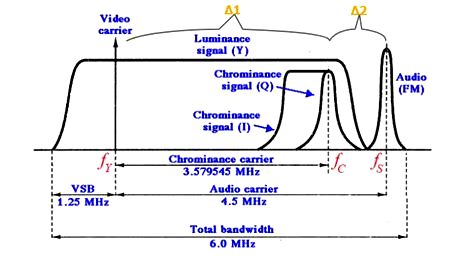
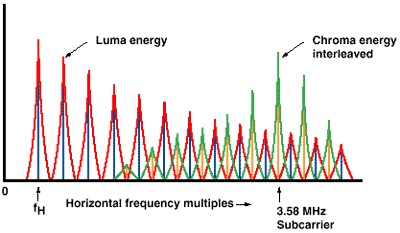
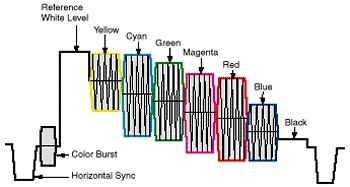
In NTSC analog television, the video signal combines luminance (brightness) and chrominance (color) information into a single composite waveform. This clever multiplexing allowed color to be added to existing black-and-white broadcasts, but it created a fundamental weakness.
Because the chroma signal is modulated onto a high-frequency subcarrier and interleaved with the luminance signal, perfect separation at the receiver is nearly impossible. The television decoder must attempt to filter out the color information without removing important brightness details.
These separation errors are especially visible on sharp edges, fine patterns like clothing or text, and during camera movement. The problem became so well-known that it earned the nickname “NTSC artifacts” and was one of the main reasons the industry eventually moved away from composite video toward component systems such as Y/C (S-Video) and later full component digital video.
The full story here.
CBS resistance. - didn't want to give their competitor (NBC - owned by RCA) any more money!
When color was added to the existing black-and-white NTSC television system in 1953, engineers faced a serious technical challenge. The original monochrome standard used a precise 60 fields per second. However, simply adding color at exactly 60 Hz caused major interference problems.
To solve this, the NTSC color committee made a very clever compromise. They slightly lowered the frame rate from exactly 60.00 Hz to 59.94 Hz (more precisely 59.94005994 Hz).
This small adjustment (a reduction of just 0.1%) shifted the relationship between the color subcarrier and the sound carrier so that the interference became much less visible.
The change was small enough that existing black-and-white televisions could still display the new color signal without noticeable issues.
The color subcarrier frequency was carefully chosen to be an odd multiple of half the line frequency.
By reducing the field rate to 59.94 Hz, the color subcarrier was placed at approximately 3.579545 MHz instead of a round number. This precise offset minimized the beating between the color and audio carriers.
In short, 59.94 Hz was not chosen for artistic or visual reasons — it was a brilliant engineering compromise to make color TV work without destroying the existing black-and-white television infrastructure.
Interlaced scanning was invented in the early 1930s and became the standard for television because it solved two critical problems at once: limited bandwidth and the physical limitations of early CRT displays.
In the early days of television, engineers had extremely limited radio spectrum available. Sending a full 60 frames per second would have required twice the bandwidth they could afford. Interlacing allowed them to send only half the picture lines per pass (odd lines in one field, even lines in the next), effectively cutting the required bandwidth in half while still refreshing the screen 60 times per second.
Early cathode-ray tube (CRT) televisions used phosphors that glowed for only a very short time after being struck by the electron beam. If a full frame was drawn at 30 frames per second, the image would visibly flicker and appear to “blink,” causing eye strain and headaches for viewers.
By alternating odd and even lines (creating 60 fields per second), the screen refreshed twice as often. The human eye and the CRT phosphor’s natural persistence combined to make the image appear steady, even though only half the lines were being drawn at any moment.
Interlacing was a brilliant engineering compromise for the technology of the 1920s–1950s. It gave viewers a smooth, high-motion picture within the tight bandwidth constraints of analog TV. However, it also introduced motion artifacts (combing, twitter, line crawl) that modern progressive-scan displays struggle with.
Even today in SMPTE ST 2110, 1080i is still supported in ST 2110-20 because many legacy news, sports, and archive systems still use interlaced workflows.
In short: Interlacing was never about picture quality — it was about making television possible with the limited technology available in the 1930s.
See the full story here
Drop-Frame Timecode is a clever adjustment used in NTSC video (29.97 fps) to keep the timecode accurate to real-world clock time.
Note: Here "fps" means "Frames Per Second," not "Fields Per Second." Remember two fields equal one frame in interlaced video.
True 30 fps video would be simple — 30 frames = 1 second. But because NTSC color television actually runs at 29.97 frames per second (not exactly 30), a normal timecode would slowly drift from real time.
After one hour, non-drop-frame timecode would be almost 3.6 seconds ahead of actual clock time. Over a long program or live broadcast, this drift becomes very noticeable.
To compensate, Drop-Frame timecode "drops" two frame numbers at the start of every minute — except every 10th minute.
This skipping happens at every minute except minutes 00, 10, 20, 30, 40, and 50. Over one hour, exactly 108 frames are dropped (3.6 seconds), which perfectly compensates for the 0.1% speed difference between 30 fps and 29.97 fps.
One of the most frustrating technical legacies of NTSC color television was the Four-Field Color Frame Sequence.
Because NTSC color uses a 59.94 Hz field rate and a very precisely chosen color subcarrier frequency, the color information repeats only every four fields (two full frames). This creates a four-field color sequence that must stay in phase for correct color reproduction.
VTRs 101
In analog video tape editing (especially with two-inch Quad, 1-inch Type C and 3/4" U-matic machines), editors needed to make clean cuts and inserts.
However, the four-field color sequence created major headaches:
The color burst (the reference signal for color) had to maintain a specific relationship with the start of each field. If two video signals were not color frame locked there were only two “legal” edit points per second where the color phase matches on both sides of the cut. Making an edit at any other point would break the color sequence, resulting in a visible glitch of shift. To combat that video tape recorders came along that would put a marker in the tapes control track indicating the start of a color field.
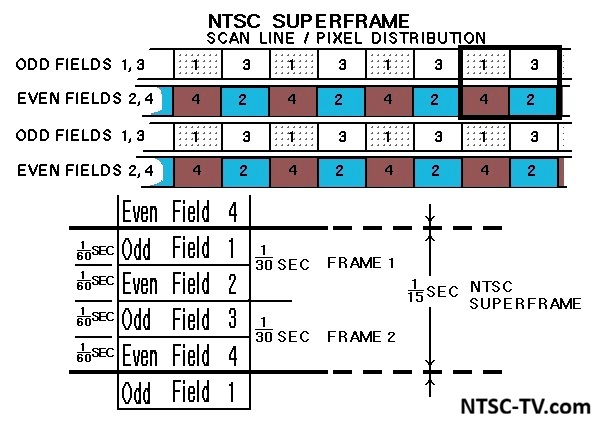
Editing systems when rolling tapes, one to record onto, the other to provide the video to record, would slew the caption servo of the playback machine so that its color field start matched the recorders.
This is one of the main reasons the industry eventually moved toward component digital video and progressive scan — to eliminate these complex analog color timing problems.
Ancillary Data (often called ANC packets) is metadata “stuffed” into the horizontal and vertical blanking intervals of a video signal.
In traditional SDI video, not every line is used for visible picture. The areas above the picture (Vertical Blanking Interval – VBI) and between pixels on each line (Horizontal Blanking Interval – HBI) are normally blank.
Engineers realized they could use this “invisible” space to carry useful data without increasing bandwidth. This data includes:
Ancillary data is organized into standardized ANC packets defined in SMPTE ST 291-1. Each packet starts with a header containing:
In traditional SDI, ANC data rides along with the video signal in the blanking intervals. When converting to ST 2110, the Gateway or encoder extracts this data and packages it separately as ST 2110-40 flows.
This separation allows ANC data to be routed independently from the video essence — for example, sending captions to one destination and video to another.
In short, Ancillary Data Packets turn the “blank” parts of a video signal into a hidden data channel that carries critical metadata throughout the production chain.
A look at Ancillary Data in SDI video.
The NFL’s current massive 11-year media rights deals include strategic opt-out clauses that activate after the 2028–29 season (following the February 2029 Super Bowl).
These clauses give the league significant flexibility to restructure its broadcasting and streaming agreements as the media landscape continues to evolve.
The NFL has already signaled its intention to exercise these opt-out rights. The goal is to adapt the league’s media strategy to the rapidly shifting streaming-dominated landscape.
In short, 2029 represents a major strategic “reset button” for the NFL’s media empire.
SMPTE ST 2110 fundamentally changed media infrastructure by shifting the conversation from “How many satellite transponders do we have?” to “How many virtualized instances can we spin up?”.
DirecTV's NFL season pass, Sunday Ticket. It lost the rights to this package to YouTube starting with the 2023 NFL season, after a seven-year deal was struck in December 2022, valued at approximately $2 billion annually.
In the old SDI/satellite world, DirecTV had to treat every game as one large “baked” signal. Features like Multiview required manually creating quad-split feeds at a central facility and beaming them up as entirely new channels.
ST 2110 changed this by breaking the signal into independent essence flows (ST 2110-20 Video, ST 2110-30 Audio, ST 2110-40 Metadata). YouTube can now dynamically assemble Multiview layouts in the cloud on the fly, based on user demand.
DirecTV’s infrastructure was hardware-defined — adding capacity or 4K support meant launching satellites or upgrading thousands of physical receivers.
With ST 2110, YouTube uses virtual gateways and Software-Defined Networking (SDN). They can instantly scale from a few games to 16 concurrent Sunday afternoon games by spinning up virtual resources in their cloud infrastructure.
Traditional satellite streaming often lagged 30–60 seconds behind live action. ST 2110 uses Precision Time Protocol (PTP) for sub-microsecond synchronization across the entire production chain.
This allows YouTube to deliver signals to their CDN much faster, significantly narrowing the “spoiler gap” that once kept fans tied to DirecTV.
ST 2110 is transport-agnostic — it works over fiber, 5G, Starlink, or any IP connection. This enabled YouTube to turn any internet-connected device into a potential NFL viewing seat, without requiring proprietary hardware like a satellite dish.
The 2026 Masters highlighted a growing tension in sports media: while there are more ways to watch than ever, the complexity of navigating them has reached a breaking point for many fans.
The tournament offered a record-breaking 27 hours of coverage, but this came at the cost of user clarity. Fans had to juggle four major platforms:
Amazon Prime Video • ESPN • CBS/Paramount+ • Golf Channel
| Feature | 1996 Coverage | 2026 Coverage |
|---|---|---|
| Total Live Hours | ~10.5 hours | 27+ hours |
| Outlets | USA Network + CBS | Prime, ESPN, CBS, Paramount+, Golf Channel |
| Tech / Access | Analog TV | 4K HDR, AI stats, multiple apps |
In the 1990s, the tournament organizers at Augusta National famously resisted expansion. They believed that broadcasting the front nine would "cut down on attendance" and that the back nine was the only "compelling" part of the course. For decades, the front nine was essentially cloaked in secrecy until 1995/1996, when coverage finally expanded past the final few holes.