1. Overview: NBCUniversal’s One Platform
NBCUniversal’s One Platform is a unified, cloud-native advertising technology ecosystem designed to eliminate fragmentation across its media portfolio. It functions as the connective tissue allowing advertisers to manage campaigns seamlessly across linear television and digital streaming through a single, intelligent interface.
2. AWS Replacement and New Services
NBCU migrated petabytes of data to a cloud-based data lake, replacing rigid on-premises server environments with elastic AWS infrastructure.
- What was replaced: Legacy "traffic" systems and high-cost physical hardware were replaced by custom-engineered, cloud-native solutions.
- New Services: Implementation of Amazon
S3
Understanding Amazon S3
Amazon S3 (Simple Storage Service) is a highly scalable, object-based cloud storage service offered by Amazon Web Services (AWS).
Core Concepts
- Objects: The fundamental unit of storage, consisting of the file itself and metadata.
- Buckets: Containers used to store objects, similar to directories in a file system.
- Keys: The unique identifier (name) for an object within a bucket.
Key Features
- Scalability: Automatically scales to handle vast amounts of data and high request rates.
- Durability: Designed for 99.999999999% (11 nines) of data durability.
- Security: Provides robust tools for encryption, identity and access management (IAM), and bucket policies.
- Lifecycle Management: Automatically transitions data to cheaper storage classes based on access patterns to optimize costs.
Common Use Cases
- Data Lakes and Analytics
- Backup and Restore
- Archiving
- Static Website Hosting
- Cloud-native Application Storage
Understanding Amazon EMR
Amazon EMR (Elastic MapReduce) is a managed cloud big data platform that simplifies running big data frameworks, such as Apache Hadoop, Apache Spark, and Presto, on AWS to process and analyze vast amounts of data.
Core Concepts
- Clusters: A collection of Amazon EC2 instances. Each instance in the cluster is called a node.
- Node Types:
- Master Node: Manages the cluster and coordinates the distribution of data and tasks.
- Core Node: Runs tasks and stores data in the Hadoop Distributed File System (HDFS).
- Task Node: Runs tasks but does not store data in HDFS; used to add extra processing power.
Key Features
- Managed Service: AWS handles cluster setup, management, and configuration, allowing you to focus on data analysis.
- Elasticity: You can resize clusters up or down to handle changes in demand, ensuring cost efficiency.
- Flexibility: Supports a wide variety of open-source frameworks beyond Hadoop, such as Hive, Pig, Flink, and more.
- Integration: Seamlessly integrates with other AWS services like Amazon S3 (for storage) and Amazon CloudWatch (for monitoring).
Common Use Cases
- Log analysis and web indexing.
- Machine learning pipelines and model training.
- ETL (Extract, Transform, Load) processes for data warehousing.
- Financial simulation and complex scientific modeling.
Understanding Amazon EC2
Amazon EC2 (Elastic Compute Cloud) is a web service that provides resizable compute capacity in the cloud. It allows users to rent virtual servers, known as "instances," to run applications without needing to purchase or maintain physical hardware.
Key Concepts
- Instances: Virtual servers that you can launch, configure, and terminate as needed.
- Amazon Machine Images (AMIs): Templates that contain the software configuration (operating system, application server, and applications) required to launch your instance.
- Instance Types: Various configurations of CPU, memory, storage, and networking capacity optimized for different use cases (e.g., compute-optimized, memory-optimized, or general-purpose).
Key Features
- Elasticity: You can scale capacity up or down in minutes, not hours, in response to traffic spikes or dips.
- Control: You have full root or administrator access to your instances, allowing you to install any software or configure settings as you would on a physical server.
- Flexibility: You can choose from various operating systems (Linux, Windows, etc.) and instance configurations to perfectly match your workload.
- Pay-as-you-go: You pay only for the compute capacity that you actually use, with various pricing models like On-Demand, Reserved Instances, and Spot Instances.
Common Use Cases
- Hosting websites and web applications.
- Running batch processing workloads.
- Supporting enterprise applications and databases.
- Development and testing environments.
- High-performance computing (HPC) and gaming servers.
Understanding AWS Lambda
AWS Lambda is a serverless, event-driven compute service that lets you run code for virtually any type of application or backend service without provisioning or managing servers.
Core Concepts
- Functions: The code you upload to Lambda. You provide your code, and Lambda takes care of everything required to run and scale it with high availability.
- Events: Lambda functions are triggered by events. An event can be a change in data (like an object uploaded to Amazon S3), an update to a database, or a request via an API.
- Triggers: The AWS services or application activities that cause your Lambda function to execute.
Key Features
- Serverless: No servers to manage. AWS handles all the underlying infrastructure, including OS maintenance, capacity provisioning, and automatic scaling.
- Event-Driven Scaling: Lambda automatically scales your application by running code in response to each trigger, scaling from a few requests per day to thousands per second.
- Cost Efficiency: You pay only for the compute time you consume. There is no charge when your code is not running.
Common Use Cases
- Data Processing: Real-time processing of files uploaded to S3 (e.g., resizing images or processing logs).
- API Backends: Running web application backends triggered by HTTP requests via Amazon API Gateway.
- Automation: Automating operational tasks, such as starting/stopping instances or creating backups based on schedules.
- Integration: Serving as the "glue" between different AWS services by transforming data or triggering workflows.
Understanding AWS Clean Rooms
AWS Clean Rooms is a service that helps companies and their partners analyze and collaborate on their collective datasets to gain insights without sharing or revealing the underlying raw data with each other.
How It Works
AWS Clean Rooms allows multiple parties to create a secure, isolated data environment (the "clean room") where they can join their data together to run queries, without any party being able to see, copy, or download the other party's raw data.
Key Features
- Data Privacy: Built-in privacy controls, such as query output restrictions and aggregation constraints, ensure that individual-level data is not exposed.
- Collaboration: Facilitates secure partnerships between brands, publishers, and agencies, particularly useful in the advertising and media industries.
- No Data Movement: Collaborators do not need to move their data out of their own AWS accounts; they simply grant permissions for the data to be analyzed within the clean room environment.
- SQL Support: Users can run familiar SQL queries to analyze combined datasets.
Common Use Cases
- Advertising Attribution: Brands and media publishers can measure campaign effectiveness by joining ad exposure data with conversion data without sharing customer lists.
- Customer Insights: Companies can combine their data with partners to get a 360-degree view of the customer journey while maintaining strict data governance.
- Market Analysis: Securely aggregating data across multiple industry participants to identify market trends without revealing proprietary business information.
3. Business Activities and Automation
The transition enabled NBCU to shift from selling static time slots to selling audiences.
- A proprietary
Log Scheduler
Business Transformation: From Time Slots to Audience-Based Selling
The transition mentioned refers to NBCUniversal’s fundamental shift in its advertising business model, moving away from the rigid, decades-old practice of selling specific broadcast time slots toward a data-driven, audience-centric approach.
The Legacy Model: Static Time Slots
Traditionally, linear television advertising was bought and sold based on static "spots." Advertisers would purchase a specific 30-second window during a program, often relying on historical demographic data and broad estimates. This process was manual, slow, and lacked the granular targeting capabilities of digital media.
The New Paradigm: Audience-Based Selling
By leveraging cloud infrastructure, NBCU now sells advertising based on specific audience segments across all platforms—broadcast, cable, and digital streaming (like Peacock). This ensures that advertisers reach their desired target demographics regardless of the specific program or time of day.
The Role of the Proprietary "Log Scheduler"
At the heart of this agility is a proprietary "log scheduler" engine built on AWS. This tool serves as the automated "brain" of the broadcast operations:
- Digital-Style Agility: It brings the speed and flexibility of digital programmatic advertising to the linear broadcast environment.
- Real-Time Optimization: Instead of finalizing ad logs days or weeks in advance, the scheduler can make adjustments dynamically.
- Second-by-Second Inventory Management: It analyzes live viewership data to optimize ad placement in near-real-time. If viewership trends shift, the system can automatically re-allocate ad inventory to ensure optimal reach and impact.
The Impact on Operations
This implementation effectively bridged the gap between legacy broadcast workflows and modern digital expectations. By automating these processes, NBCU reduced operational friction, increased the efficiency of ad inventory usage, and provided advertisers with higher precision and ROI tracking comparable to digital-first platforms.
4. Transformation of "Traffic" Systems
Rather than adopting off-the-shelf software , NBCU custom-engineered its advertising ecosystem. By integrating AWS core infrastructure with specialized services, they successfully bridged the gap between traditional linear scheduling and the requirements of modern multi-platform delivery.
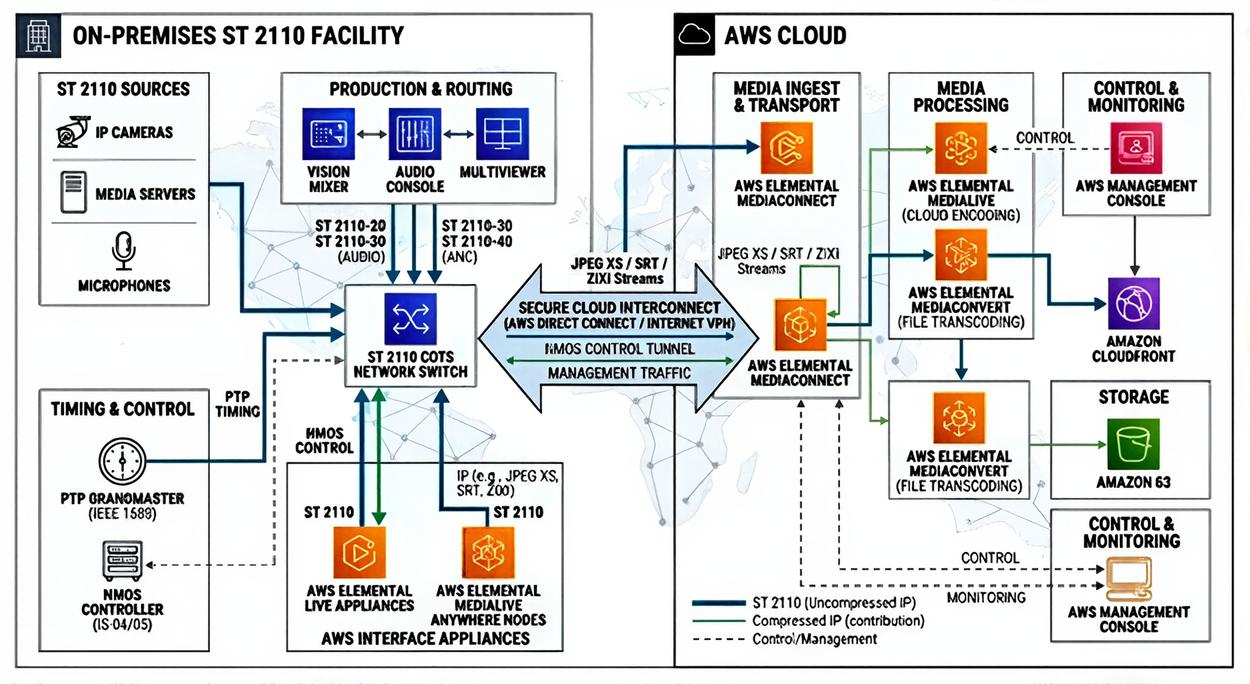
Understanding the Hybrid Broadcast Architecture
The provided graphic illustrates the integration of a professional on-premises broadcast facility with cloud-based distribution, often referred to as a Hybrid Broadcast Architecture.
The On-Premises ST 2110 Facility
This section represents the high-performance local studio environment:
- ST 2110 Sources: Physical ingest points including IP cameras, media servers, and microphones.
- Production & Routing: Hardware responsible for vision mixing, audio processing, and monitoring.
- ST 2110 COTS Network Switch: The central hub using SMPTE ST 2110 for transporting uncompressed media over IP.
- Timing & Control: Uses PTP (Precision Time Protocol) to ensure millisecond-accurate synchronization across all local hardware.
The Bridge: Connecting to the Cloud
This critical infrastructure enables the secure transition of media from the studio to the cloud:
- Secure Cloud Interconnect: A dedicated, high-bandwidth path (e.g., AWS Direct Connect) acting as the main pipe.
- AWS Elemental Appliances: Acts as the "translator" by encoding raw ST 2110 signals into cloud-ready formats like JPEG XS, SRT, or Zixi.
- NMOS Control Tunnel: Allows the local control systems to extend their reach into the cloud, managing remote resources as if they were local hardware.
The AWS Cloud Ecosystem
Once in the cloud, media is processed for global distribution:
- Media Ingest & Transport: AWS Elemental MediaConnect manages the reliable receipt of incoming streams.
- Media Processing: AWS Elemental MediaLive (for live encoding) and MediaConvert (for file-based transcoding) prepare the assets.
- Control & Monitoring: The AWS Management Console acts as the centralized interface for engineers to monitor the entire workflow.
- Distribution: Amazon CloudFront delivers the finalized content to global end-users.
Summary of the Flow
The diagram demonstrates a transition from siloed, fixed hardware to a software-defined infrastructure. By combining the low-latency precision of local ST 2110 production with the massive, elastic scalability of the AWS Cloud, broadcasters can maintain high-quality output while achieving modern distribution agility.
5. AWS Elemental Live Appliances
These high-performance, rack-mountable devices function as the "eyes and ears" of the studio. They ingest raw SMPTE ST 2110 signals at the edge, convert them into transport-ready formats (e.g., JPEG XS), and bridge the local facility to the AWS Cloud for global distribution.
6. The Modern Data Stack
NBCU's intelligence layer consists of:
- Data Warehouse: Optimized for rapid, structured business reporting.
- Data Lake: A low-cost, massive repository for unstructured raw data.
- Data Lakehouse: A hybrid architecture (e.g., Databricks) combining warehouse performance with lake capacity.
7. Streaming and Infrastructure
AWS handles the complex streaming chain using AWS Elemental MediaConnect for secure transport and Amazon CloudFront for global content delivery. While broadcast and streaming paths were once separate, they are increasingly integrated within the cloud broadcast chain.
8. SMPTE ST 2110 Correlation
While there is no direct technical link between data stack tools (like Databricks) and the ST 2110 protocol, there is a clear operational synergy: ST 2110 acts as the "pipe" for live broadcast signals, while the Modern Data Stack acts as the "brain" for optimizing the business and advertising value of those signals.