In a REMI (Remote Integration Model) or "At-Home" production, the field production truck undergoes a massive identity shift. Traditionally, a truck was a "mobile television station" full of switchers, audio consoles, and replay servers. In a 2110-based REMI setup, the truck becomes a high-density edge device.
Its primary job is to capture "essence" (raw video and audio), packetize it, and haul it back to a central facility over a Wide Area Network (WAN).
The "Thin" Truck Architecture
In a full REMI model, the truck is "thin." You won't find a 10-row production switcher or a full audio suite inside. Instead, the truck contains:
Stageboxes/Fiber Converters: Devices that take local SDI or XLR inputs and convert them immediately to ST 2110-20 (Video) and 2110-30 (Audio).
Minimal Monitoring: Just enough screens for the engineering team to verify that the cameras are shaded and the microphones are "hot."
The "Brain" is Elsewhere: The actual Vision Mixer (Switcher) and Audio Console are physically located hundreds or thousands of miles away at the "Home" station.
High-Density Encoding (The Gateway)
Since raw 1080p video is ~3 Gbps and 4K is ~12 Gbps, you cannot send multiple uncompressed streams over a standard internet or leased line without immense cost.
JPEG-XS (ST 2110-22): This is the "gold standard" for REMI. It provides visually lossless compression with ultra-low latency (less than a frame). The truck uses hardware encoders to shrink that 3 Gbps stream down to ~200-400 Mbps for the trip home.
HEVC/H.264: Used for lower-priority return feeds or "talent" monitors where a bit more latency is acceptable.
PTP and Timing (The WAN Challenge)
This is the hardest part of a REMI truck model. The truck needs to stay in sync with the home base.
GPS-Locked Grandmasters: The truck carries its own Grandmaster clock locked to GPS.
PTP Translation: Engineers must ensure the PTP timestamps from the truck can be reconciled with the PTP timestamps at the home facility so that when the Director hits "Cut," the video and audio from the field are perfectly aligned.
The "Long Haul" Connectivity
The back of the truck looks less like a patch bay and more like a telecom hub:
Diverse Paths: Usually, two separate fiber paths (Provider A and Provider B) for ST 2022-7 redundancy. If a backhoe digs up one fiber line, the broadcast stays on air.
Data Orchestration: Software (like NMOS or proprietary controllers) manages the "handshake" between the truck and the home facility to ensure the streams find their destination.
REMI Truck vs. Traditional OB Van
Feature
Traditional OB Van
REMI Field Truck
Primary Goal
Finish the show inside the truck
Get the raw signals to the "Home" base
Staffing
Full crew (Director, Audio, Replay, etc.)
Skeleton crew (Engineers, A2s, Camera Ops)
Equipment
Full Switchers, Routers, Audio Boards
Encoders, Gateways, PTP Clocks
Output
A single "Program" feed
The situation today
Today there are three types of trucks in the NEP fleet. Ignoring support, and other types, such as the sandbox truck. REMI (knowing that this is a workflow not an architecture), SDI/hybrid, & 2110. The 2110s use TFC and IP heavy hardware.
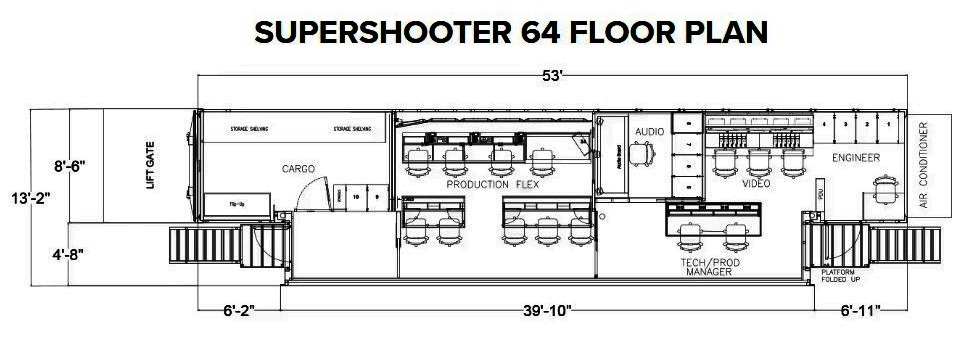
Based on the equipment list for Supershooter 64, this is primarily an SDI-based truck, though it is designed with modern hybrid capabilities.
While it is a high-end unit, it lacks the massive IP fabric (core switches like Arista or Cisco) and the "Gateway" infrastructure typically seen in a native SMPTE ST 2110 environment.
Here is the breakdown of why it falls into the SDI category:
Key SDI Indicators
Router: It uses a Ross 12G Ultrix, which is a high-performance SDI/12G hybrid router. While Ultrix can handle IP via software licenses, its primary strength in this configuration is SDI/12G-SDI.
Cameras: The Sony HDC2500 and HDC4300 units listed are traditional SDI output cameras (though the 4300s are 4K-ready).
Monitoring & Distribution: The presence of AJA FS HDR frame syncs and UDX converters points toward a traditional "baseband" SDI signal flow where signals are converted and synced individually rather than being managed as IP streams.
Cabling: The inventory specifically lists Mini Triax and 9mm SMPTE (fiber for cameras), which are standard for SDI mobile units. A 2110 truck would typically highlight a heavy reliance on 100G/25G fiber trunks for its core infrastructure.
The "REMI" Distinction
The spec sheet notes it is a REMI HD mobile unit. In the context of NEP's fleet, this means it is optimized for "Remote Integration," where the truck acts as a capture site and sends feeds back to a central hub (like NEP Encompass or VISTA). While it uses IP for the transport of those feeds (likely via the Ross Ultrix or additional encoders), the internal "guts" of the truck remain SDI.
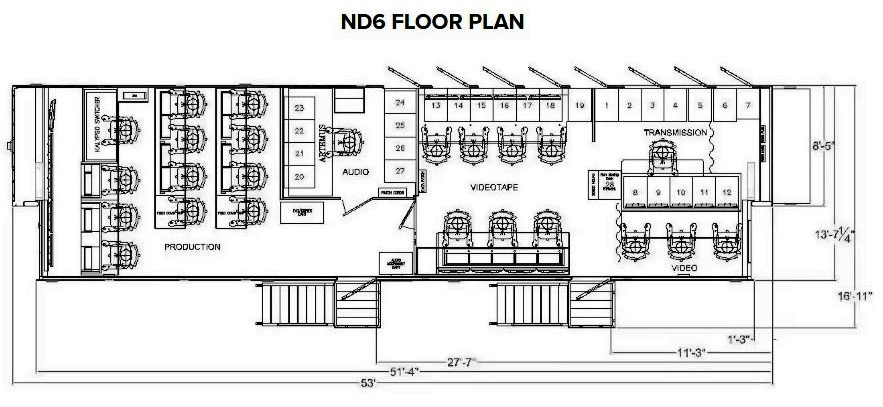
Based on the equipment list for NEP ND6, this truck is an SDI-based unit with high-end capabilities for HDR and 4K, but it is not a native 2110 IP truck.
Here is the technical breakdown of why it fits the SDI classification:
Traditional SDI Core
Video Router: It uses a PESA HD video matrix (288 inputs x 288 outputs). Unlike NEP’s 2110 trucks (which use Cisco or Arista IP switches and "TFC" control), this is a dedicated "baseband" SDI router.
"Digital Glue" & Processing: The list features a heavy reliance on AJA FS2 and FS-HDR frame synchronizers and Cobalt 9000 series cards. These are used to process, sync, and convert individual SDI signals—a hallmark of traditional truck architecture.
Camera Infrastructure
Cameras: The truck carries Sony HDC3500 and HDC4300 cameras. While these cameras are modern and "IP-ready," the ND6 configuration uses them with standard CCUs (Camera Control Units) on board and lists SMPTE 12mm and Mini Triax cabling. In a native 2110 truck, you would typically see "Native IP" camera chains (like the LDX series) that bypass traditional CCU-to-router SDI connections.
Audio & Cabling
Audio: It uses a Calrec Artemis Shine console with Hydra II field boxes. While Hydra II is a networked audio protocol, in this truck, it serves as the backbone for a traditional SDI video environment rather than a fully unified ST 2110-30/31 IP audio fabric.
Cables: The inclusion of extensive Assorted Single Line Coax and Triax identifies it as a copper-heavy SDI environment. Native 2110 trucks (like NEP's EN or Al-Ula series) have a "significant reduction in cabling" and rely almost exclusively on high-density fiber (TAC-12/24) for signal transport.
Is it "REMI"?
While not branded specifically as a "REMI" truck like Supershooter 64, ND6 can perform REMI (Remote Integration) workflows. The spec sheet notes it is "capable of 1080p, HDR or 4K" and has fiber transmitters/receivers, allowing it to send feeds back to a central hub. However, its internal "guts" remain firmly in the SDI domain.
Summary:
SDI: Yes (Core infrastructure)
2110: No (Lacks the IP switch fabric/TFC control)
REMI: Capable (but not its primary "class" name)
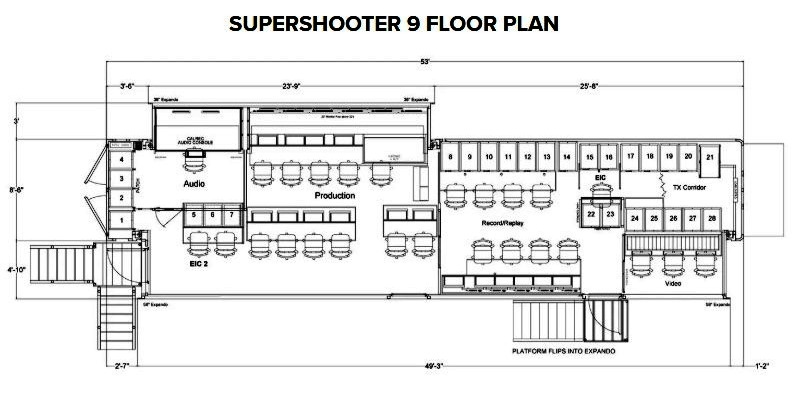
One of the most prominent examples of a native SMPTE ST 2110 IP truck in the NEP fleet is Supershooter 9.
While the trucks you looked at previously (Supershooter 64 and ND6) are built on SDI cores, Supershooter 9 was specifically designed as a "standalone 1080p HDR/4K-capable" unit built around a modern IP fabric.
What makes Supershooter 9 a 2110 Truck?
Unlike the SDI trucks, the equipment list for Supershooter 9 highlights a "Software-Defined Network" architecture:
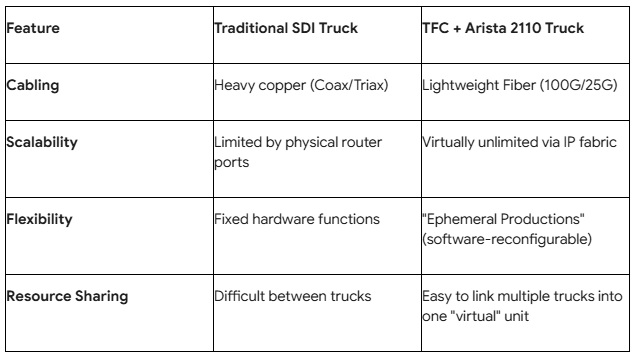
Core IP Router: Instead of a traditional baseband matrix (like PESA or Evertz EQX), it uses the NEP TFC (Total Facility Control) system integrated with Arista IP Switches. This allows it to route video, audio, and data as separate "essence" streams over a 100G/25G fiber backbone.
IP Processing: It features the Lawo V_matrix platform. This is a "blade-based" system where the same hardware can perform different tasks (multiviewing, routing, or processing) depending on the software license loaded—a key feature of 2110 environments.
Native IP Audio: The Supershooter 9 audio suite is "heavy on IP," utilizing 512 AoIP (Audio over IP) and 128 Dante inputs/outputs directly into the Calrec Apollo console, rather than relying on MADI or analog conversions.
Intercom: It uses the RTS Adam system with OMNEO, which is the IP-based transport for RTS intercoms that is fully compatible with ST 2110-30.
Other Notable NEP 2110 Trucks
Beyond Supershooter 9, NEP has several other native IP units globally:
EN3: Noted as NEP U.S.’s first single-truck unit with IP-based routing and their first full SMPTE 2110 deployment.
Venus and Ceres (NEP UK): These sister trucks were built to be part of what was at the time the world's largest ST 2110 IP system for major events like Wimbledon.
EU-03 (NEP Europe): A recently modernized unit that underwent a full ST 2110 transition to support software-defined production workflows.
Summary Comparison: If you look at the Supershooter 9 specs, you'll see "Arista IP Router" and "TFC Control" listed right at the top of the Support Equipment section—this is the "smoking gun" that tells you a truck is 2110 native.
In NEP's 2110 trucks, the combination of an Arista IP Router (Switch) and TFC (Total Facility Control) replaces the traditional hardware-based SDI matrix with a software-defined, virtualized routing environment.
The Arista IP Router: The "Muscle"
Instead of a traditional video router (like Pesa or Evertz), these trucks use "Commercial Off-The-Shelf" (COTS) high-performance network switches from Arista.
Massive Bandwidth: Unlike SDI routers that have a fixed number of physical ports, Arista switches (like the 7500 series) provide up to 28.8Tbps of throughput. This is enough to handle thousands of uncompressed 4K and HDR streams simultaneously.
Essence-Based Routing: In an SDI truck, video and audio are often "embedded" together in one cable. In the Arista IP environment, video, audio, and metadata are sent as separate SMPTE ST 2110 "essences." The Arista switch treats these as data packets, allowing them to be routed independently to any destination.
TFC Control: The "Brain"
NEP TFC (Total Facility Control) is a proprietary software platform that acts as the orchestration layer for the entire truck. It sits on top of the Arista hardware to make complex networking feel like a traditional broadcast environment.
Simplification for Humans: IP networking is notoriously complex, requiring deep IT knowledge. TFC uses an intuitive interface that allows broadcast engineers to route signals using "tags" and names (e.g., "Cam 1 to Monitor 4") without ever touching a command line or managing IP addresses.
Software-Defined Networking (SDN): TFC acts as the SDN controller. It automatically manages bandwidth and network flows to ensure that high-priority video streams never "buffer" or drop frames, providing the "lossless and deterministic" performance required for live TV.
Multi-Vendor Integration: TFC is "technology agnostic." While the Arista switch handles the data, TFC coordinates with equipment from various manufacturers (Sony, Grass Valley, Calrec, Lawo) sIo they all talk to each other seamlessly over the IP fabric.
Why use them together?
In summary, the Arista switch provides the raw power and high-speed data lanes, while TFC provides the intelligent control and user-friendly interface that makes high-stakes live production possible in an all-IP environment.
TFC Control and NMOS
We should be clear the the TFC Control does not replace NMOS. Instead, they work together at different layers of the broadcast stack to manage a 2110 environment.
Think of it this way: NMOS is a universal language (the protocol), and TFC is the fluent translator and manager (the orchestration platform).
How They Work Together
NMOS (The Standard): NMOS (Networked Media Open Specifications) provides the standard way for devices to talk to each other. For example, NMOS IS-04 handles "Discovery and Registration" (a camera saying "I'm here"), and IS-05 handles "Connection Management" (the command to link that camera to a switcher).
TFC (The Orchestrator): NEP TFC is the "Broadcast Controller" that sits on top of these protocols. It uses NMOS to "see" and "talk" to third-party equipment (like Sony cameras or Calrec audio consoles). If a camera is NMOS-compliant, TFC can automatically discover it and bring it into the truck's routing system without manual IP configuration.
Why TFC is "More" Than Just NMOS
While NMOS provides the basic connection, TFC adds layers that NMOS doesn't cover:
SDN (Software-Defined Networking): TFC manages the Arista or Cisco network switches directly to ensure there is enough bandwidth for a video stream before it's allowed to move.
Tagging System: TFC allows operators to use human-friendly tags (e.g., "End Zone Cam") rather than managing long lists of IP addresses or NMOS UIDs.
Security: TFC adds an authentication layer to ensure only authorized users can change routes, which is a critical feature for high-profile events like the Super Bowl.
Multi-Protocol Support: Not every device supports NMOS perfectly yet. TFC is "technology agnostic," meaning it can use NMOS where available but can also use proprietary APIs or even older protocols to control legacy SDI gear in the same interface.
Summary
You can't "replace" NMOS with TFC because TFC uses NMOS as one of its primary tools to achieve interoperability between different brands of equipment. Without a platform like TFC, you would have to manage NMOS streams manually, which is extremely difficult in a fast-paced live production environment.
In the Supershooter 9 (and similar NEP IP units like Supershooter 6), the Grass Valley Kayenne X-Frame interfaces with the NEP TFC / Arista core through a "Spine-and-Leaf" architecture.
Rather than plugging BNC cables into a central router, the switcher is treated as a high-bandwidth network node. Here is how the interface works:
Physical Connectivity (The "Leaf")
The Kayenne X-Frame engine (the "brain") is equipped with high-density IP I/O boards (typically 25G or 100G).
These boards connect directly to the Arista IP Switch (the "Leaf" switch) via fiber optic cables using SFP28 or QSFP transceivers.
Unlike an SDI switcher where every input is a separate wire, all 128 inputs and 96 outputs mentioned in the SS9 spec sheet travel over these high-speed fiber trunks as SMPTE ST 2110 data packets.
Signal Discovery (NMOS)
When the Kayenne is powered on, it uses NMOS IS-04 to introduce itself to the network.
It essentially broadcasts: "I am a Grass Valley switcher, and I have these available input 'sinks' and output 'sources'."
NEP TFC sees these NMOS registrations and automatically populates them into its database, making the switcher's ports available for routing without manual IP configuration.
Orchestration & SDN (The TFC "Brain")
This is the most critical part of the interface. When a Technical Director (TD) wants to route "Camera 1" to "Switcher Input 5," they do it through a TFC panel or a standard router head.
Bandwidth Management: Before TFC makes the connection, its Software-Defined Networking (SDN) layer talks to the Arista IP Router. It calculates if there is enough bandwidth on the fiber link to handle the stream (especially for 4K/UHD).
The "Virtual" Route: Once approved, TFC tells the Arista switch to "multicast" the Camera 1 stream to the specific IP address assigned to the Kayenne's Input 5.
Redundancy (ST 2022-7)
The interface is almost always "Hitless." The Kayenne X-Frame has two sets of IP ports (Primary and Secondary) connected to two separate Arista switches (the "Red" and "Blue" or "Amber" and "Purple" networks).
If a fiber cable is kicked out or a switch fails, the switcher identifies the identical data packets from the other network, ensuring the broadcast never drops a single frame of video.
Control (OOB Management)
While the video/audio (the "essence") travels over the Arista 2110 network, the Kayenne Control Panel in the production room talks to the X-Frame engine over a separate, dedicated "Out-of-Band" (OOB) management network. This ensures that even if the video network is under heavy load, the TD's button pushes are always instantaneous.
The NEP TFC interface is designed to make complex IP networking "human-friendly," allowing production teams to manage routing and infrastructure via an intuitive, web-based touchscreen GUI.
On trucks like Supershooter 9 and Supershooter 10, the TFC interface is deployed across the truck on various touchscreen panels and operator stations.
Key Visual & Functional Elements of the TFC GUI:
Intuitive Routing ("Human" Language): Instead of managing long lists of IP addresses or technical UIDs, the interface uses human-friendly tags and names (e.g., "Camera 1," "EVS A," or "Director Monitor").
Web-Based Interface: The TFC platform features an elegant web UI that can be accessed from any authorized device on the network, providing a consistent look and feel across different mobile units and production hubs.
Modular Control Panels: Operators can use software-driven touchscreens that supplement or replace traditional hardware control surfaces. These are often used for:
Signal Routing: Quick "touch-to-route" functionality for video, audio, and data.
Real-Time Monitoring: Instant visual feedback on network health, including uptime, latency, and device status.
Preset Templates ("Ephemeral Productions"): A specialized feature that allows production teams to instantly reconfigure an entire control room between shows using pre-defined templates.
Scalable Workspaces: The new system user interfaces allow key personnel to customize their own workstation layouts, streamlining setup and reducing workload during fast-paced live events.
Where You'll See It in the Truck:
In a modern 2110 unit, you will find these TFC touchscreens at:
Technical Manager/Engineer Stations: For high-level system orchestration and SDN (Software-Defined Networking) management.
Production Benches: For TD (Technical Director) and Producer routing of multiviewers and monitors.
Audio & Replay Areas: For managing specific IP audio flows and server connectivity.
Visual Reference: You can see a walkthrough of how this interface is used behind the scenes in the TFC Explained
video
provided by NEP Group.
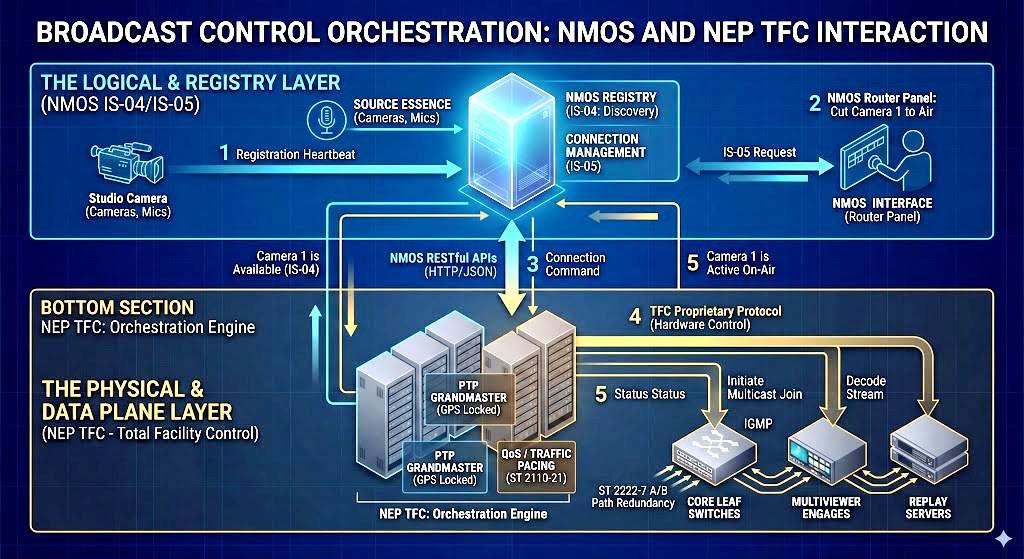
NMOS + NEP TFC Control Architecture
The graphic separates the control environment into two primary hierarchical sections to show the boundary between "Logical Discovery" and "Physical Execution."
1. Top Section:THE LOGICAL & REGISTRY LAYER (NMOS IS-04/IS-05)
This is the "logic and discovery" environment featuring the NMOS Registry and Connection Management (IS-05) servers.
An icon shows a camera sending a Registration Heartbeat, proving it exists.
Another shows a user sending a Routing Request (IS-05 "Cut Camera 1") to the NMOS server.
2. Bottom Section:THE PHYSICAL & DATA PLANE LAYER (NEP TFC - Total Facility Control)
This is the high-performance NEP TFC Orchestration Engine — a robust server node operating in a "hardware and deterministic" environment.
It contains core functions like PTP Grandmaster locking and QoS Traffic Pacing (ST 2110-21), essential for fabric health.
The Interaction (How They Talk):
A bold bidirectional arrow connects the two sections, labeled 'NMOS RESTful APIs (HTTP/JSON)'.
Step One (Discovery): A 'Studio Camera' (Source) sends a 'Registration' to the NMOS Registry. NMOS then tells TFC: "Camera 1 is Available (IS-04)".
Step Two (Routing Request): A user pushes a button (Cut Camera 1 to Air). This sends an 'IS-05 Request' to the NMOS server.
Step Three (TFC Action): The NMOS server sends a 'Connection Command' via the APIs to the NEP TFC server.
Step Four (Physical Execution): The NEP TFC server sends immediate, sub-millisecond hardware commands to the 'CORE LEAF SWITCH' to 'Initiate Multicast Join' (IGMP) and to the 'Multiviewer' to 'Decode Stream'.
Step Five (Status Update): The hardware sends status back to TFC, which updates NMOS: "Camera 1 is Active On-Air".
Summary
This diagram proves that NMOS is the brain (Discovery and Logic) and TFC is the muscle (Execution and Fabric Determinism). They communicate over open APIs, creating a flexible, standard-based control plane that can manage proprietary hardware.
12G-SDI verses SMPTE ST 2110 (IP over Ethernet)
Aspect
12G-SDI (and SDI family)
SMPTE ST 2110 (IP over Ethernet)
Transport Method
Dedicated coaxial cable or fiber (point-to-point)
Packets over standard IP networks (Ethernet switches, often 10/25/100G fiber)
Signal Composition
Single multiplexed stream (video + embedded audio + ancillary data)
Separate "essences" (independent video, audio, metadata streams)
Bandwidth per 4K60
~12 Gbps per cable (one stream per cable)
~12 Gbps per stream, but scalable/multicast via network (multiple streams share bandwidth)
Higher Resolutions
Good for 4K/UHD (single cable); 8K requires multiple cables or new standards
Native support for 4K/8K+ (scales with network capacity; easier for HDR/HFR)
Latency
Extremely low (sub-frame, deterministic)
Very low (sub-frame possible with proper PTP sync); slightly higher than SDI in some setups
Synchronization
Genlock or embedded black burst
Precision Time Protocol (PTP via SMPTE ST 2059) for precise timing across network
Scalability & Routing
Limited (physical cables, dedicated routers; hard to expand)
Higher for large-scale (more cables/routers as channels grow)
Lower (COTS IT hardware, efficient bandwidth use; 20-30% savings over 5 years in large facilities)
Current Adoption (2026)
Dominant in legacy/medium facilities (~82% use SDI infrastructure); hybrid common
Growing fast in new/large builds (~30% overall; 60-65% in Tier-1/major facilities; tipping point in live sports/events)
Best For
Smaller studios, OB vans, legacy upgrades, ultra-reliable point-to-point, cost-sensitive ops
Large-scale, future-proof facilities; 4K/8K live production; remote/cloud/hybrid workflows
Long-Term Outlook
Will persist in niches (small ops, certain long-haul links) but gradually phased out
The future standard for core broadcast infrastructure (overwhelming industry direction)
Key Takeaways
Hybrid is reality in 2026: Most facilities use both (SDI edges + IP core, with gateways/converters like AJA or Cobalt bridging them).
When to choose 2110: New builds, high-channel counts, remote production, or anything needing scalability/cloud.
When to stick with 12G-SDI: Keeping it simple, budget constraints, or where absolute deterministic reliability trumps flexibility.
Practical Engineering: Let's look one final time what the truck environment has to master regarding 2110. Most would agree that the reliability of the broadcast and the speed of the setup (the "strike and set") are more important than the theoretical benefits of the technology.
1. The Interoperability & Configuration Gap
Here are the biggest "pain point" of SMPTE ST 2110: It is not "Plug and Play."
The "Stability" Argument: In a fixed facility (like a TV station), 2110 is great because once a camera is assigned an IP, it stays there for years. In a remote truck, you might have 10 cameras today and 40 tomorrow.
The "Orchestration" Solution: 2110 by itself is just a transport protocol; it has no "manager." This is exactly why NEP built TFC (Total Facility Control). TFC acts as a translator so that a crew can plug in a new device and have it "just work," mimicking the SDI behavior many engineers miss. Without a layer like TFC, an engineer would have to manually configure IP addresses and multicast flows for every single new device.
2. 12G SDI vs. 2110: Complexity vs. Capability
The many advocates for 12G SDI for high-pressure events (Music/Awards). This is a very common sentiment among "A-list" engineers for several reasons:
Troubleshooting: If an SDI signal is missing, you use a waveform monitor or a handheld "dirt box" to see if there is a signal on the wire. In 2110, if a signal is missing, you are looking at data packets, PTP sync issues, and switch logic.
Latency: While 2110 is extremely low-latency, the processing of those packets can add layers of complexity that 12G SDI simply doesn't have. For a live award show where timing is everything, "simple" is often "safe."
3. The "90-Minute Boot" Problem
This is a famous (and very real) problem with using high-end Cisco Nexus switches in mobile environments.
(Mitigating)
Cisco/Arista Boot Times: A large enterprise-grade switch (like a Cisco 9000 series) performs massive self-checks, builds routing tables, and establishes security protocols upon power-up. In a stadium where power can be flaky, a 90-minute recovery time after a power "hit" is a broadcast nightmare.
SDI Speed: A Pesa or Evertz SDI router is "dumb" by comparison — it’s essentially a giant crossroads of copper. It boots almost instantly because it isn't trying to be a computer; it's just a switchboard.
4. The "Denali" Perspective
Looking at Denali (NEP’s elite fleet used for the Oscars, Grammys, and American Idol) is significant. Those trucks are built for "mission-critical" audio and video. If a Denali engineer says 90 minutes is too long to wait for a switch to boot, it’s because their "Show Start" time is a hard deadline that doesn't care about network convergence.
Summary from a "Retired Pro" Perspective:
What is being highlighted is a transition period in the industry. 2110 is not bad technology — but it was designed by IT people for data centers, and then forced into trucks for broadcasters.
Platforms like NEP TFC were created specifically to bridge this gap, essentially "tricking" the 2110 system into acting like the stable, fast-booting, easy-to-configure SDI systems that the "go-to" people of the last decade trusted.
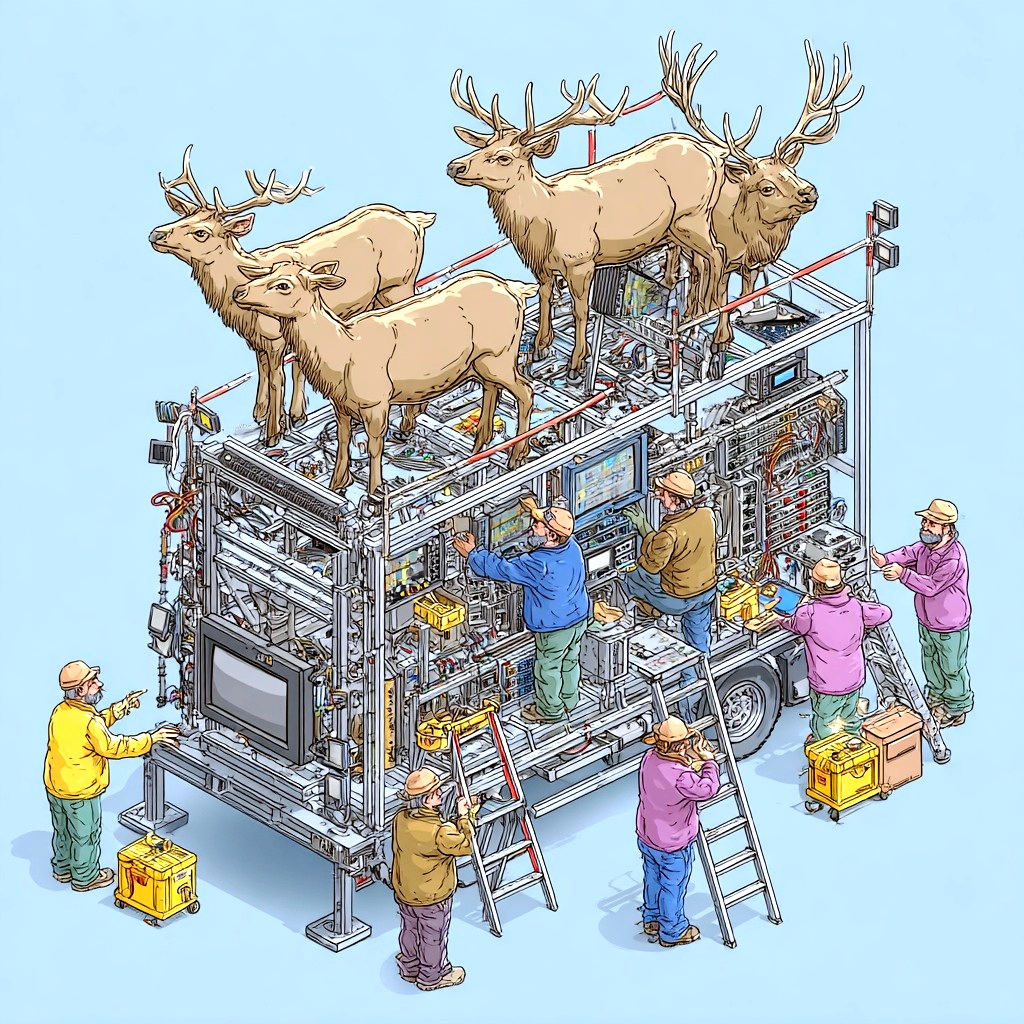
Below what a 2110 truck might at first glance look like to a "traditional" engineer!