 Study Plan
2110 Topo
Study Plan
2110 Topo
This lesson explains ST 2110 orchestration and how it fits into the SMPTE ST 2110 stack in modern broadcast operations.
• The Subtleties: 2110 vs. NMOS vs. Orchestration
• Riedel / Cisco Relationship
• GV AMPP as Super-Orchestrator
• NEP’s TFC: Manager of Managers
• Ross Video: The Hyperconverged Philosophy
• The "Switzerland" Vendors: Specialist Orchestrators
• Orchestration in 2026: AI & Federation
• How the Ecosystem Evolved
• AMPP and ST 2110: How They Complement Each Other
• When One Takes Precedence
• Summary: Which to Choose?
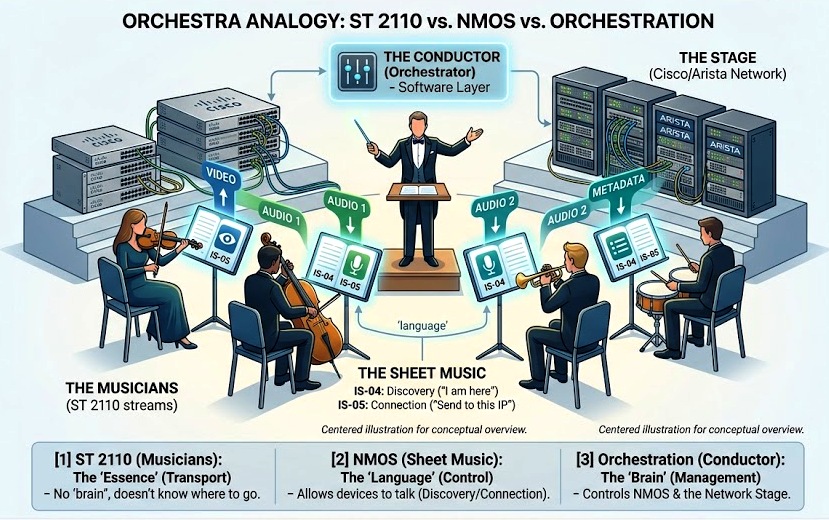
 ST 2110 (The Musicians): This is the raw "essence" (Video, Audio, Metadata) moving as independent RTP streams. It is the transport standard, but it has no "brain"—it doesn't know where to go.
NMOS (The Sheet Music): Developed by AMWA, NMOS (Networked Media Open Specifications) is the open language that allows devices to talk to each other.
Orchestration (The Conductor): This is the software layer that tells the NMOS "Sheet Music" what to do and ensures the network "Stage" (Cisco/Arista) is ready for the performance.
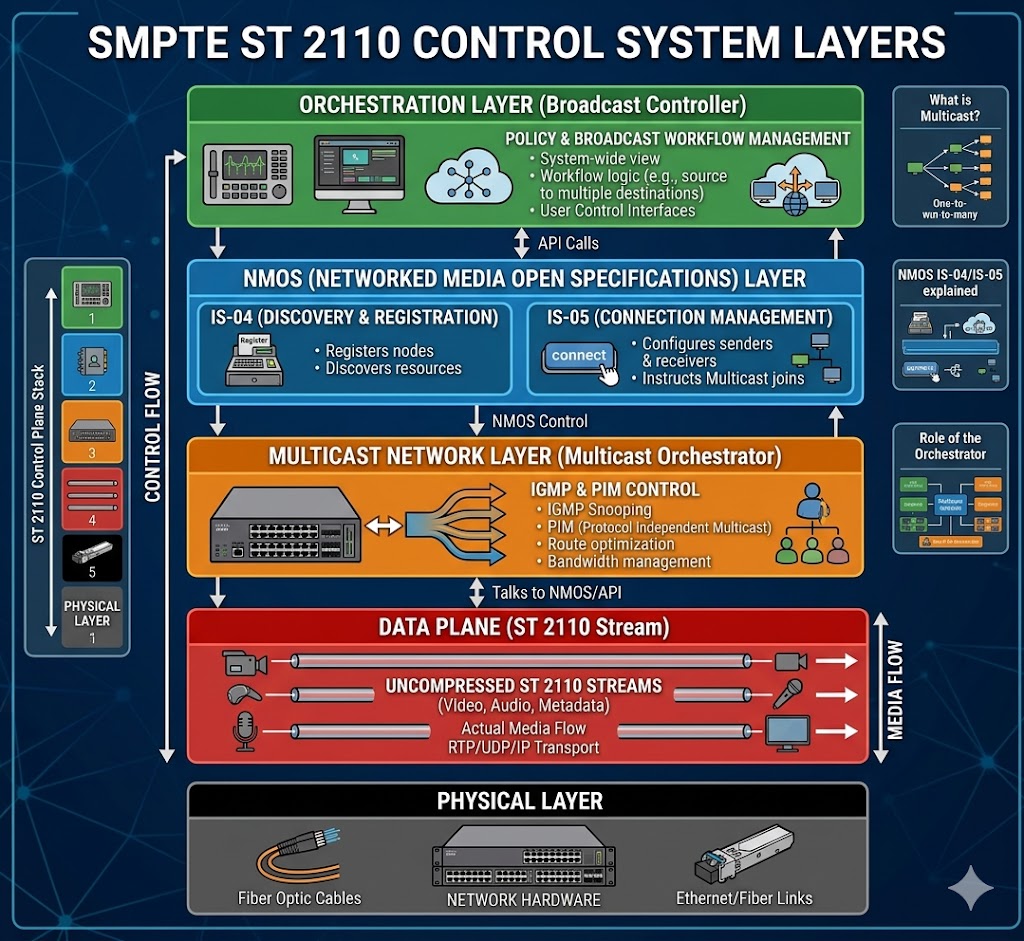
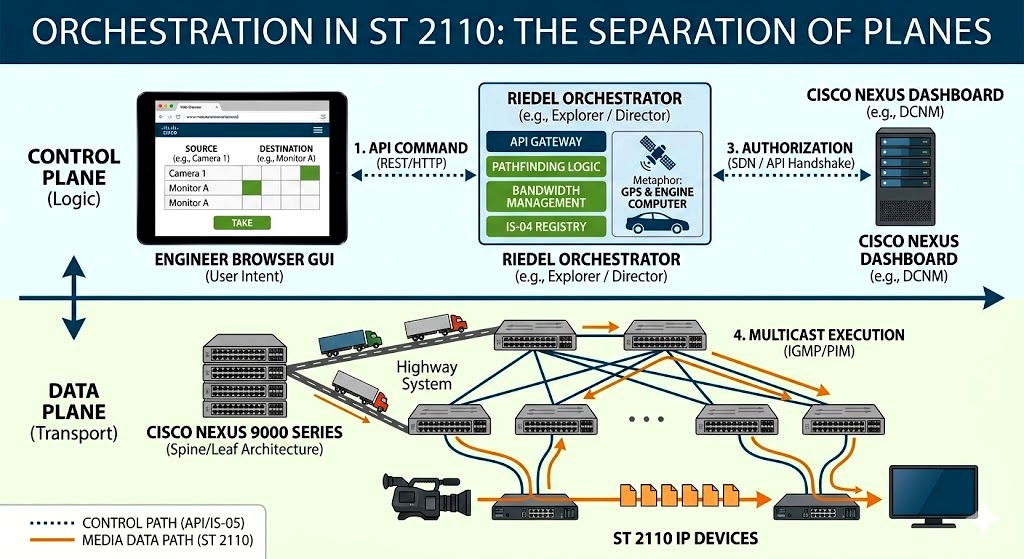
First let's look at a common division of "labor between the orchestration, NMOS, and switching layers.
The relationship between Riedel and Cisco in an ST 2110 environment is a classic example of the "Separation of Planes." To understand this, we have to look at the Control Plane (the brain) and the Data Plane (the muscle).
The "Web Server" Misconception
When engineers interact with Riedel orchestration software—such as Explorer or Director—they are often using a web-based GUI. This creates the illusion that the "Web Server" is the thing routing the video.
In reality, the Riedel Orchestrator acts as a centralized logic engine. It hosts a web interface for user interaction, but its primary job is to serve as an API Gateway between human intent and network execution. It never touches the actual video essence; it only manages the "permission" for that video to move.
The Process: From Browser to Cisco Router
The journey from a user click to a multicast flow involves several distinct steps:
| Component | Function | Metaphor |
|---|---|---|
| Browser GUI | User Interface | The Steering Wheel |
| Riedel Orchestrator | Control Plane / Logic | The GPS & Engine Computer |
| Cisco Nexus | Data Plane / Transport | The Highway System |
By separating these layers, the system remains Deterministic. Even if the Riedel "Web Server" were to be disconnected, the existing video flows on the Cisco fabric would continue uninterrupted, as the switch already has its instructions.
Yes, but it's a "Super-Orchestrator."
As you can see from the Grass Valley AMPP page you’re viewing, AMPP is a Cloud-Native Live Production Platform.
While a system like Riedel might focus on routing hardware signals in a building, AMPP orchestrates microservices. It spins up a virtual switcher, a virtual multiviewer, and virtual audio mixers in the cloud or on-prem. It handles the essence flows (the 2110/SRT/NDI streams) between these virtual bits of software. It is orchestration at the application level, not just the network level.
NEP’s TFC (Total Facility Control) is what we call a Control System or User Interface Layer.
NEP builds massive mobile units and broadcast centers. They don't want their operators to have to learn the deep technical menus of Grass Valley, Riedel, and Cisco separately.
While Grass Valley separates the "Ground" and "Cloud," Ross Video focuses on Hyperconvergence—consolidating the router, switcher, and multiviewer into unified hardware.
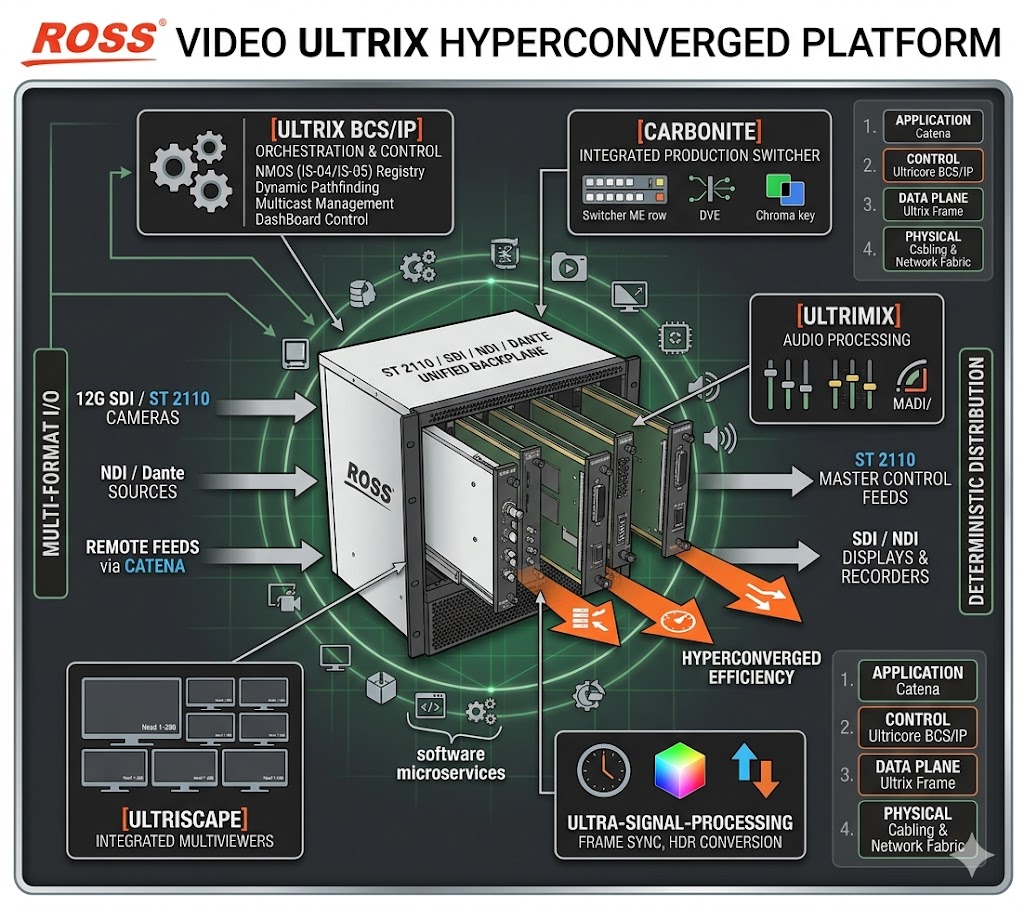
The Ross Video Ultrix hyperconverged platform is designed to consolidate a massive amount of traditional broadcast hardware into a single, software-defined chassis.
1. The Unified Backplane (The Core)
At the center of the platform is the ST 2110 / SDI / NDI / Dante Unified Backplane. Unlike traditional routers that only move signals, this backplane allows different signal types to coexist. You can ingest 12G SDI cameras alongside ST 2110 essence flows, and the system treats them as native internal sources.
2. Multi-Format I/O (The Blades)
The graphic shows the modular "blades" or cards that slide into the frame:
3. Integrated Software Microservices
The "Hyperconverged Efficiency" comes from licensing software to perform tasks that used to require separate racks of gear:
4. The Hierarchy of Control
The diagram above breaks down the management stack:
Why "Hyperconverged"?
This approach is about Efficiency. By keeping the routing, switching (Carbonite), and multiviewing (Ultriscape) inside one box, you eliminate thousands of cables and multiple points of failure. It provides "Deterministic Distribution," meaning the signals move with predictable, ultra-low latency because they never have to traverse an external network to be processed.
In a "Best of Breed" facility, you may use a third-party "Manager of Managers" to talk to everyone else:
The conversation at NAB 2026 has shifted toward automation and global connectivity:
| Concept | 2026 Advancement |
|---|---|
| Self-Healing Fabrics | Orchestrators use predictive analytics to automatically re-route 2110 flows if a switch port shows packet drops. |
| AMPP Federation | Allows different organizations to securely "link" their cloud ecosystems for global resource sharing. |
| Sustainability | "Power-Aware" routing that suggests lower-bandwidth options like JPEG-XS to reduce the carbon footprint of a production. |
The AMPP Federation allows these two distinct layers to "handshake" securely. It means a ground-based system (like an NEP mobile unit running TFC) can securely link its local signal orchestration with a broadcaster’s cloud-based AMPP instances.
The Result: You can move signals from a physical camera on the ground into a virtual switcher in the cloud and back again without manual "translation" or jumping between different control interfaces.
The industry is shifting from simple routing to deep device control:
In practice: Instead of just routing a camera signal, a "Device Level" orchestrator allows you to change the camera's gain, shutter speed, or tally status from the same unified interface (like EVS Cerebrum or GV Orbit) without needing the manufacturer's specific remote control panel.
This highlights that the "Silo" approach—where you need a different app for every brand of gear—is crumbling in favor of this deeper, device-level orchestration.
It evolved through three distinct phases:
| Phase | Reality | The Problem |
|---|---|---|
| The SDI Era | One cable = one signal. Routers were "dumb" and just flipped physical switches. | Not scalable; heavy cables. |
| Early IP (The Wild West) | Every vendor had a "black box." A Grass Valley camera couldn't talk to a Sony switcher without a "translator." | Total vendor lock-in. |
| The 2110/NMOS Era | The industry agreed on 2110 (transport) and NMOS (control) so different brands could finally "plug and play." | Complexity. You now need an "Orchestrator" to manage thousands of IP addresses. |
The Result: We now have a "Best of Breed" ecosystem. You use Cisco for the "Big Pipe," Riedel or Imagine for the "Signal Management," and GV AMPP or TFC for the "Creative Interface." They all talk to each other over the network using APIs and NMOS.
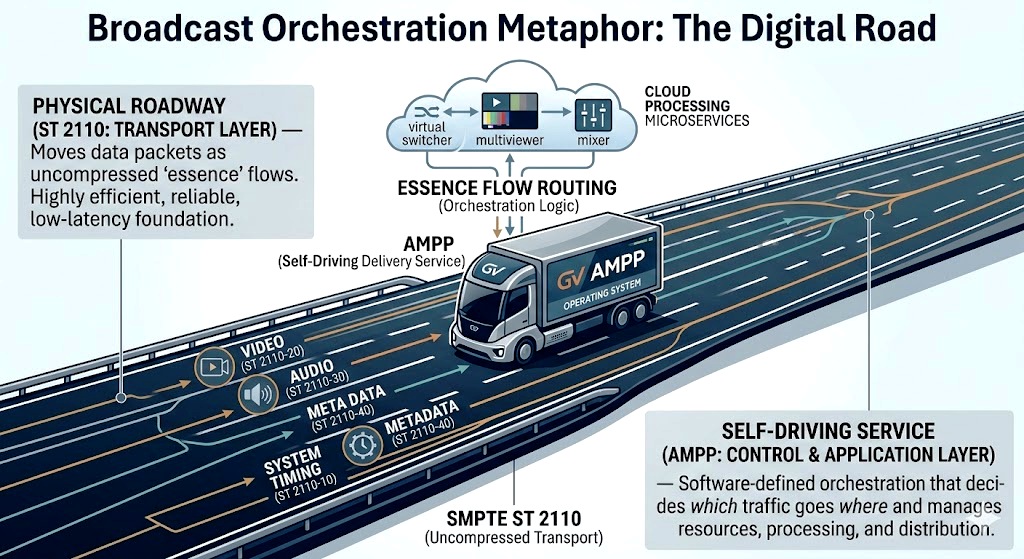
ST 2110 is the Standard for Transport: It defines how uncompressed "essence" (video, audio, and data) is chopped into packets to move across a high-speed network. It is "dumb" transport—it moves the data but doesn't know why it’s moving it.
AMPP is the Operating System: It is a software-defined platform that handles the processing (switching, mixing, graphics). AMPP can take in ST 2110 streams from your cameras, process them in a virtual switcher, and then output an ST 2110 stream back to your monitors.
The "Handshake": Grass Valley uses AMPP Edge as a bridge. An AMPP Edge node sits on your local network, ingesting ST 2110 streams from your physical hardware and "on-ramping" them into the AMPP software environment. This allows you to mix local uncompressed 2110 sources with remote SRT or NDI feeds seamlessly.
While they work together, the "Priority" shifts based on your Latency requirements and Location.
Scenario A: ST 2110 Takes Precedence (The Hardware-First Build)
Scenario B: AMPP Takes Precedence (The Software-First Build)
Summary: Which to Choose?| Factor | ST 2110 Priority | AMPP Priority |
|---|---|---|
| Primary Goal | Ultra-low latency, uncompressed signal integrity. | Agility, remote collaboration, and cost-scaling. |
| Infrastructure | Heavy local networking & expensive specialized hardware. | Lean local hardware; heavy reliance on Cloud/Compute. |
| Best For | Major live sports (Super Bowl, Olympics), Master Control. | Tier 2/3 Sports, Corporate Events, News secondary feeds. |
| Complexity | High. Requires deep IT/Network engineering skills. | Medium. Simplified UI, but requires cloud/API knowledge. |
| Feature | GV Orbit (Grass Valley) | Ultricore BCS / IP (Ross Video) |
|---|---|---|
| Registry Role | Acts as the central NMOS Registry. It listens for "Heartbeats" from new devices. | Acts as the NMOS Registry specifically tuned for the Ultrix hyperconverged fabric. |
| Discovery Logic | Distributed: Scans the network for any IS-04 compliant device (cameras, gateways, etc.) and populates a global database. | Converged: Prioritizes internal "virtual" senders/receivers within the Ultrix frame first, then scans the external IP fabric. |
| User Interface | Provides a "Node View" where engineers can see the registration status and health of every NMOS endpoint. | Uses DashBoard to display a unified table of registered senders and receivers. |
| Device Control | Uses IS-04 data to automatically populate GV Orbit's bulk configuration tools. | Uses IS-04 data to map streams directly to Ultrix virtual inputs for immediate routing. |
| Quarantine / Security | Integrates with Lawo HOME or internal logic to "verify" devices before they are fully registered in the production pool. | Relies on the Ultricore database to validate that new devices match the facility's expected IP schema. |
GV Orbit is generally more "Network-Agnostic": It is built to be the brain for a massive, multi-vendor network where devices are constantly being added and moved.
Ross Ultricore is "Fabric-Optimized": It excels when it is managing the Ross Ultrix backplane, making the registration of internal modules (like the Carbonite switcher) instantaneous and invisible to the user.
In 2026, the best orchestration isn't the one with the most features; it's the one that makes the underlying IT complexity invisible so folks can focus back on the being creatative.
The Bottom Line: You use ST 2110 when you need to "own the wire" and want the absolute fastest, highest-quality path between two points in a building. You use AMPP when the "wire" doesn't matter as much as the flexibility of where and how you produce the content.