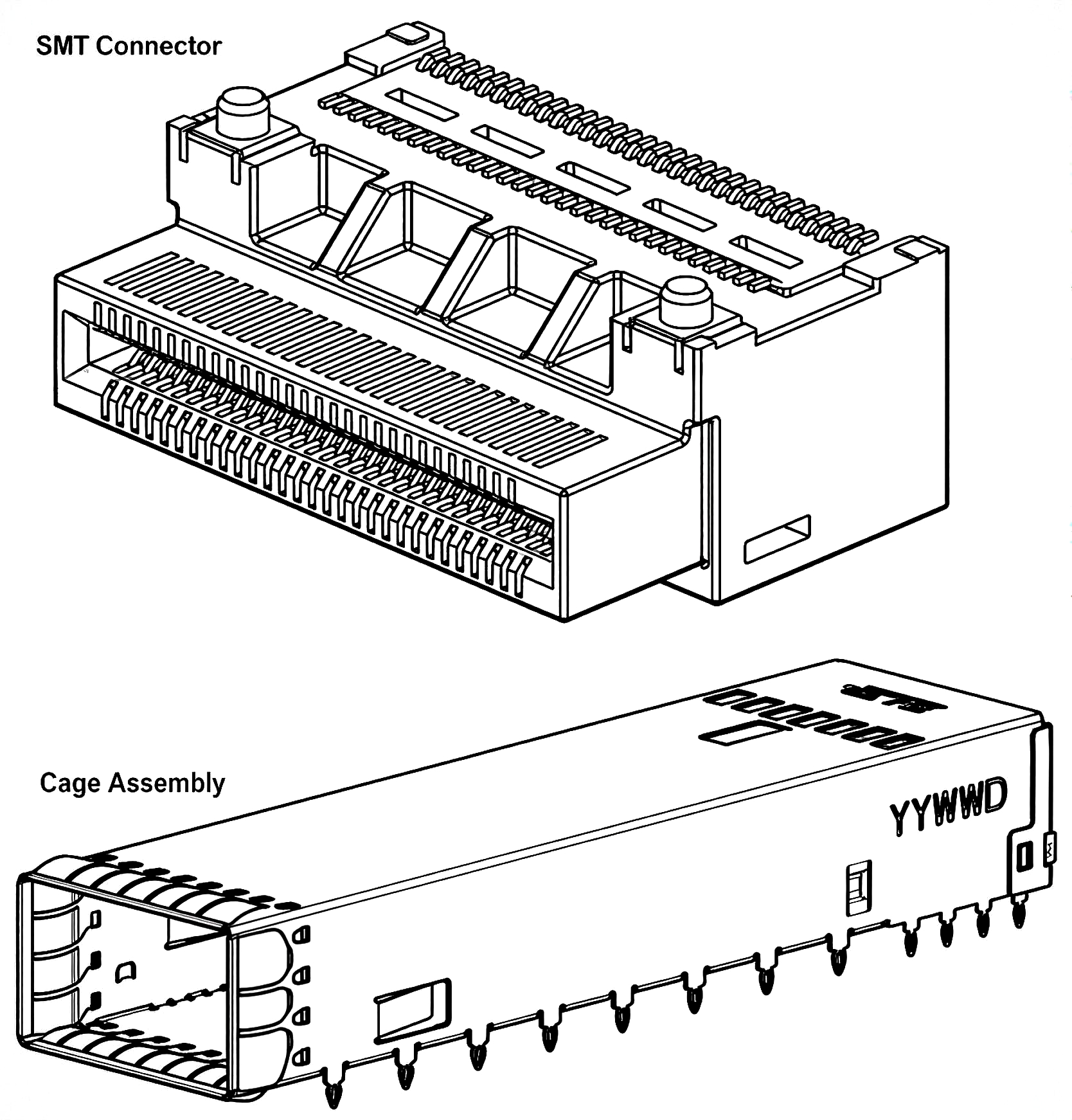
An OSFP port is a hot-swappable transceiver slot on switches/routers/servers used for very high-speed Ethernet links—typically 400 GbE and 800 GbE—via optics or DAC/AOC cables (often supporting breakouts like 2×200G or 4×100G).
OSFP “octal” refers to its 8 electrical lanes that carry 50G/100G per lane depending on the generation.
In an OSFP, the “8 electrical lanes” are eight high-speed SERDES links between the switch ASIC and the module—each lane is its own TX/RX differential pair that carries a chunk of the total bandwidth.
For 400G OSFP, it’s typically 8 × 50 Gb/s PAM4 = 400 Gb/s.
For 800G OSFP, it’s 8 × 100 Gb/s PAM4 = 800 Gb/s.
Inside the module, those lanes may map 1:1 to fibers (e.g., DR8), be gearboxed into fewer higher-rate optical channels (e.g., FR4 with 4 wavelengths), or be split for breakout (e.g., 4×100G). Forward-error correction (FEC) on the host side keeps the very high-rate lanes reliable.
A SERDES (Serializer/Deserializer) link is a high-speed interface that converts wide, slow parallel data inside a chip into a serial bitstream for transmission over a pair of differential wires—and does the reverse on receive.
Each SERDES “lane” has a TX pair and an RX pair with clock/data recovery, equalization, and encoding (e.g., NRZ or PAM4) so it can move tens or hundreds of gigabits per second reliably over copper traces or fiber modules.
Where you’ll see it:
Ethernet ports (QSFP-DD/OSFP): 8 SERDES lanes from the switch ASIC to the module (e.g., 8×50G for 400G, 8×100G for 800G).
PCIe, SATA, CXL, JESD: all use SERDES to push high bandwidth over a few pins instead of wide buses.
Short version: SERDES turns many slow internal bits into a few extremely fast serial lanes (and back), enabling modern high-speed I/O.