When to choose what
- Stay in L2 (switching) when:
- Devices must be in the same subnet/VLAN (e.g., IP cameras to a local recorder).
- You need simple, fast east-west connectivity inside a rack/floor.
- Route (L3) when:
- You need segmentation between networks (e.g., users vs. servers vs. control).
- You’re crossing sites, doing policy/QoS, NAT, or multicast across subnets.
- You want fault isolation—broadcast storms or loops in one VLAN won’t impact others.
 ST 2110 / media-centric notes
- Inside a 2110 production VLAN, use switching with proper IGMP Snooping (+ querier if no L3) to keep multicast flows scoped.
- Between production islands / to cloud / to MCR, use routing (often OSPF/IS-IS internally, PIM for multicast, and BGP toward WAN/cloud).
- Determinism: prefer P2P routed links for backbone paths; keep VLAN blast radius small; size buffers/QoS for PTP, audio, and video flows.
Sumary:
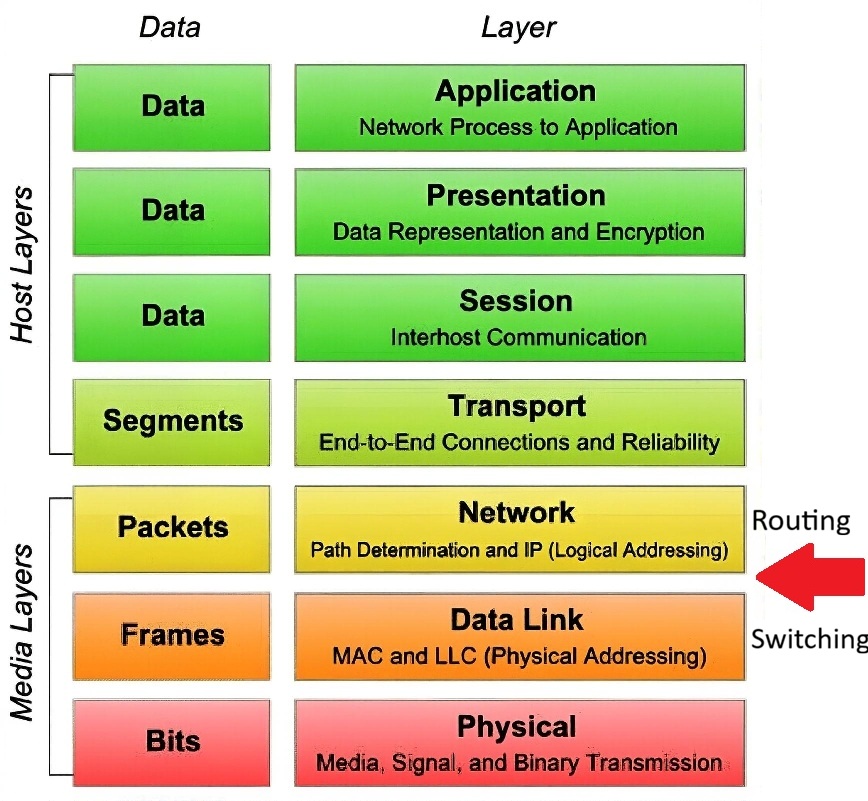
Switching = L2, MAC-based, inside a VLAN.
Routing = L3, IP-based, between subnets.
Modern L3 switches do both, so the “versus” is mostly about where in the topology you apply L2 vs. L3 functions.

UPDATED
5/20/26
V260520-1.0

 Study Plan
2110 Topo
Study Plan
2110 Topo