 Study Plan
2110 Topo
Back to the Web
Study Plan
2110 Topo
Back to the Web
Wavelets, JPEG XS, MPEG, and HEVC in ST 2110 / Cloud Workflows
In a SMPTE ST 2110 facility, uncompressed video can require very large network bandwidth. JPEG XS is used as a contribution or mezzanine compression method because it preserves the low-latency feel of uncompressed video while reducing the bandwidth required to move signals across IP networks or into the cloud.
JPEG XS: Near-Uncompressed Compression
JPEG XS is fundamentally different from traditional JPEG, MPEG, H.264, and HEVC because its main design goal is not maximum compression. Its main design goal is ultra-low latency, low complexity, and visually lossless quality.
Traditional codecs such as MPEG, H.264, and HEVC are optimized to reduce file size or streaming bandwidth as much as possible. They often do this by analyzing multiple frames over time. JPEG XS, by contrast, is designed to process video as it flows through the system, making it suitable for live broadcast, remote production, ST 2110 transport, and cloud contribution.
Why JPEG XS Is Different
- Ultra-low latency: JPEG XS can compress and decompress video with extremely small delay, sometimes measured in only a few lines of video.
- Visually lossless quality: It is designed to be visually transparent, meaning the decoded image should be nearly indistinguishable from the original source.
- Low complexity: JPEG XS requires less processing power than heavier codecs such as HEVC, making it suitable for FPGA, appliance, and embedded broadcast implementations.
- Bandwidth reduction: JPEG XS typically provides modest compression, often in the range of 2:1 to 10:1, enough to make 4K and 8K workflows more practical over IP links.
MPEG / HEVC Versus JPEG XS
| Codec Type | Primary Goal | Latency Behavior | Best Use |
|---|---|---|---|
| MPEG / H.264 / HEVC | Maximum compression efficiency | Higher latency because the codec may analyze multiple frames or groups of pictures | Streaming, distribution, VOD, consumer delivery |
| JPEG XS | Low latency and near-uncompressed quality | Very low latency because it processes video in small line-based chunks | Live production, ST 2110 transport, remote production, cloud contribution |
MPEG and HEVC are like saying, “Wait for the whole frame or group of pictures, then process.” JPEG XS is like saying, “Process the picture as it flows through the wire.”
Wavelet-Based Transformation
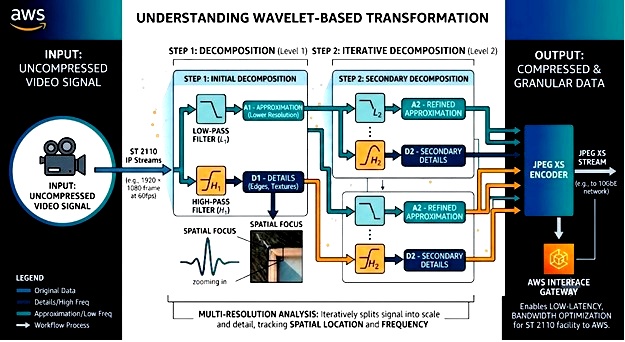
JPEG XS uses a wavelet-based transformation. A wavelet transform is a mathematical method for breaking an image into different levels of detail. It shows both where visual detail exists in the image and what kind of detail it is.
Unlike methods that look at an entire signal as one large block, wavelets provide a multi-resolution view of the image. This allows the encoder to preserve important visual detail while compressing less important information.
How Wavelet Processing Works
- Decomposition: The image is passed through filters that separate broad image structure from fine detail.
- Low-pass filtering: Smooth areas and general shapes are separated into an approximation layer.
- High-pass filtering: Edges, texture, sharp transitions, and fine details are separated into detail layers.
- Iterative refinement: The process can be repeated to create multiple levels of detail, allowing the image to be compressed intelligently.
Why Wavelets Fit JPEG XS
- Spatial awareness: The encoder knows where important detail exists in the image.
- Progressive structure: Coarse image information and fine image information are separated naturally.
- Low overhead: The method avoids the heavy processing associated with more complex inter-frame codecs.
- Line-by-line operation: The signal can be processed in small chunks, keeping delay extremely low.
Broadcast Meaning
In a 2110 facility, the goal is often to make an IP network behave like the old SDI cable: immediate, reliable, and responsive. JPEG XS helps accomplish that by reducing bandwidth without introducing the delay associated with traditional distribution codecs.
For cloud contribution, this means an AWS Elemental Live appliance or similar edge device can ingest ST 2110, compress it using JPEG XS, and send it across a secure connection such as AWS Direct Connect or MediaConnect. Once in the cloud, the signal can then be processed, transcoded, stored, or distributed.
Summary
MPEG, H.264, and HEVC are excellent for final distribution because they squeeze video into small bitrates. JPEG XS is different. It is designed for live professional workflows where latency, image quality, and responsiveness matter more than maximum compression.
JPEG XS is not trying to make the smallest possible file. It is trying to make compressed video behave as much like uncompressed video as possible.